Intro to coiling
One way to ease the "crunching" effort but ski still as much or even more effectively is to add some separation in the form of coiling - we touched on this every now and then, let's have a "formal" introduction.
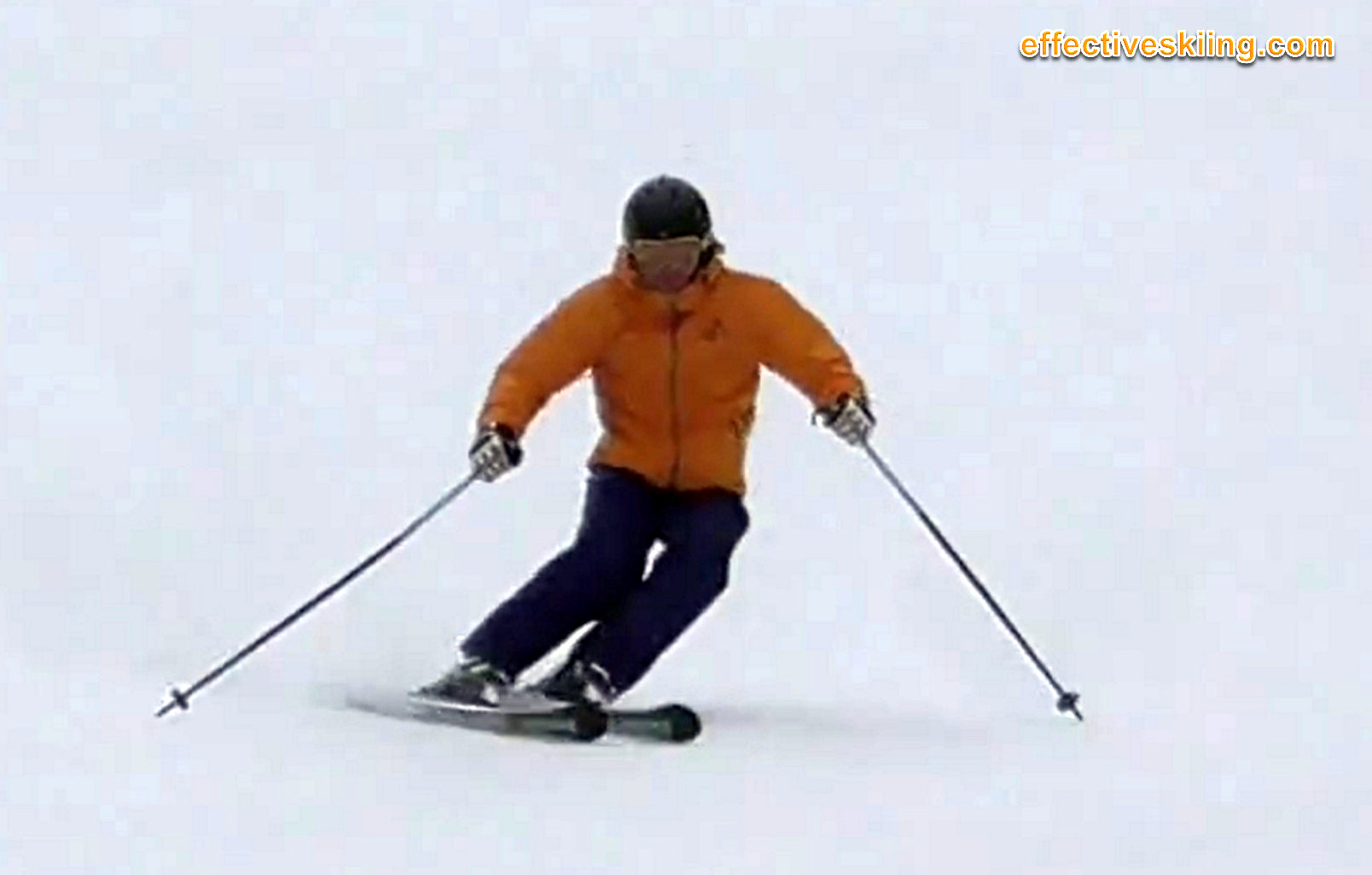
As you can see above, the shoulders are not perpendicular to the skis anymore, but very countered (typical for the end of the turn). If you draw the line of the shoulders and compare with the direction of the skis, it is easy to notice they are no longer aligned, i.e. good separation was created, in the form of coiling .
Instead of thinking "outside shoulder over outside ski" think "inside shoulder over the outside ski". This will counter your body in addition to the crunching, making everything easier, let's check it out:
Get the skis on a green or blue run. Leave the poles. Tip the skis from the lower body and compensate with the upper body.
As you tip the skis inside the turn more, also tip the outside shoulder to the outside until you feel "the crunch" on the outside.
Now start to counter the body to the outside of the turn a bit so start to tip the inside shoulder over the outside ski. Do this in relation to how much the skis turn.
Counter, counteraction
Although the general principle of separation is about separating lower and upper body in general, the term "separation" is customarily used to denote counter: i.e. this turning of the upper body to the outside of the turn, counter to the lower body turning with the skis.
Think of a point of view anchored to the upper body: in that case the lower body is turning inside the turn, while the upper body does not turn much. If your point of view is fixed to the skis, then the lower body doesn’t actually do much as it is turning with the skis, while the upper body is turning to the outside.
Note in the sequence below how the shoulders and hips stay fairly stable while the skis turn quite significantly underneath, requiring effort of both the upper and lower body:
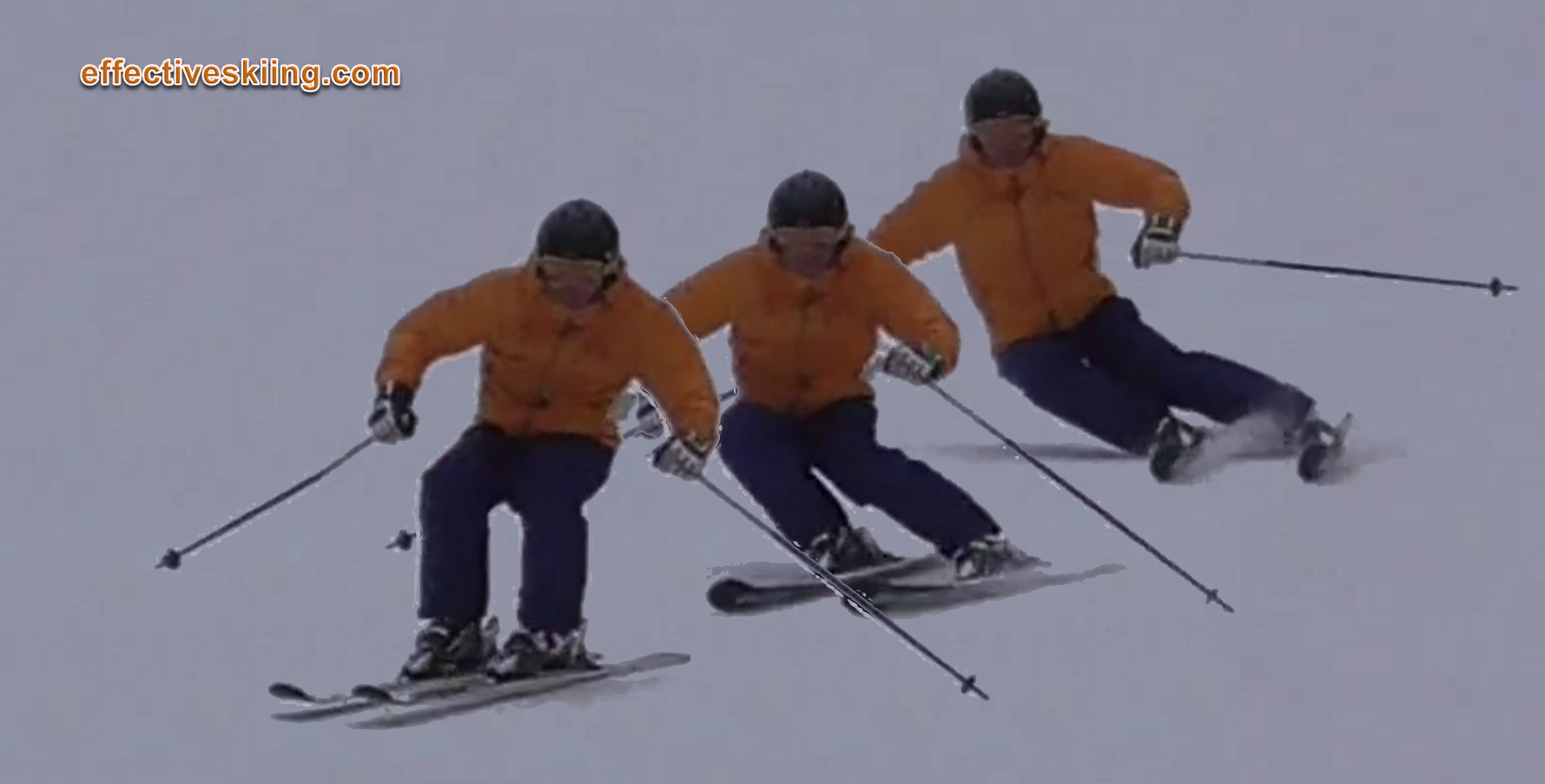
Reality is in-between, it depends on the level of skiing. While it's true that the skis turn and the upper body would like to follow them, the skis are guided by the snow while the upper body has inertia, so if you keep a loose core, it would turn less anyways, if you time the turn right and manage to stay in balance.
The critical ingredient for separation and coiling is maintaining sufficient relaxation of the mid-body, to allow the upper and lower to function separately.
Nevertheless, it is much more effective to think of this counter as a conscious effort as opposed to something that just happens.
The term counteraction denotes this fact that the upper body should be turning contrary to the lower body, because in reality, the lower body will turn with the skis so the actual effort should be to keep the upper body from turning, by turning it the other way.
Shuffle and counteraction
Maybe it's a little early for heavy technique discussions, but have a look at this photo - as the skis turn to the inside (3) you see the shoulders countering to the outside (4).
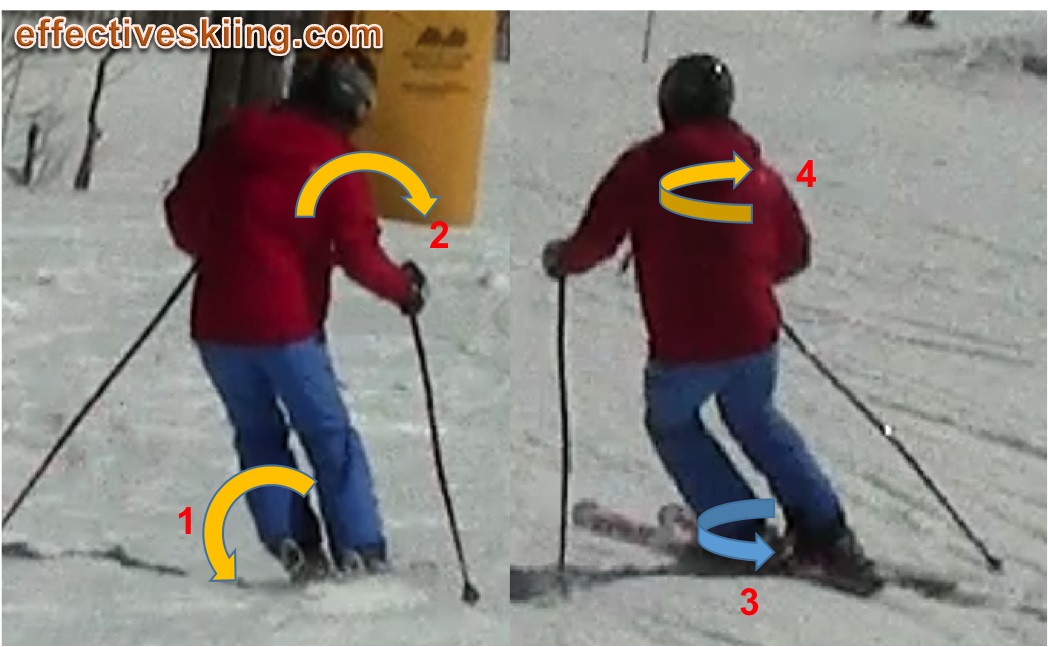
However, what you also see is that the inside ski (left) has shuffled ahead a bit, creating tip lead so that the boots, hips and shoulders kind of match.
Some argue that this is sufficient counter and that it is a result of the ski shuffling forward. That is not correct. While related, these two are different movements and when we talked about separating upper and lower body, we were serious, especially as we are always trying to keep or pull back that inside foot...
The counter or counter-action rotating the shoulders (and hips at the higher levels) to the outside of the turn is a separate movement from shuffling the boots forward. Also, the body tension resulting from counter, the coiling cannot happen if we just shuffle.
While strongly related through the bio-mechanics of how our bodies are articulated, and usually considered OK for high-speed large GS turns, these are still independent movements, especially as we angulate a lot in powerful short turns.
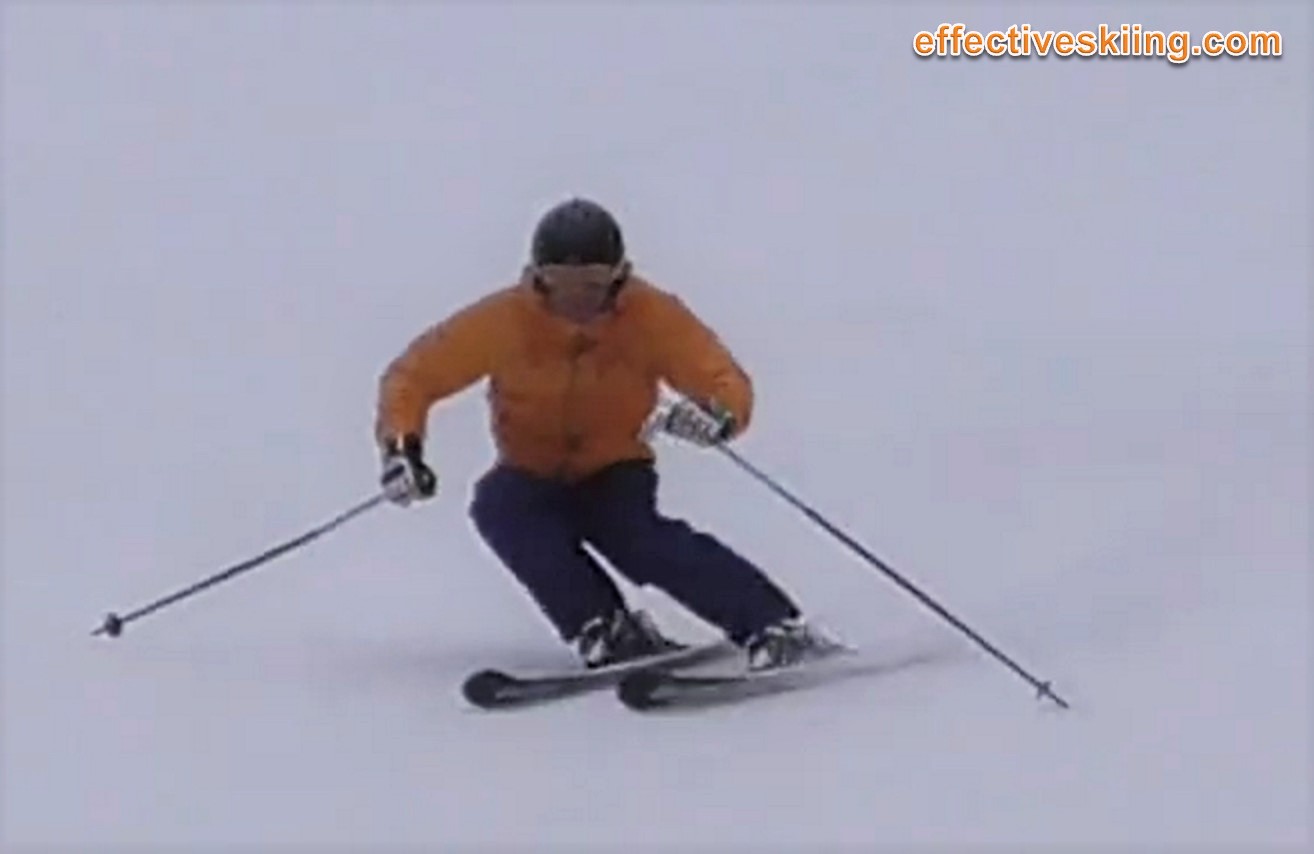
In that photo above, I was really cruising at low speeds, so I got a little lazy :) . Here's the same but in the middle of some high performance slalom turns on a black and you can clearly see the difference between the minimal inside tip lead and the pronounced countering of the torso there:
Anyways, just something to remember for those intense technique debates during apes-ski. Again, while related and really dependent on how athletic you are, the kinds of turns you make and how much the skis come out of the fall line (i.e. how across the hill you finish the turn), these are different movements. For more cocktail chatter, read Steering and coiling.
Too much
While you should exaggerate when learning, there is however the issue of too much counter, with some negative consequences, which you must watch out for.
Too much counter leads to Hip dump, which is also related to the shuffling of the feet and results generally in a static, park and ride kind of skiing, Not to mention too much movement/rotation of the upper body.
This is an issue more in GS or long turns, were there is sufficient time.
Counteraction
This movement is also called Counteraction. Let's separate it out in our movements and work on it for a while.
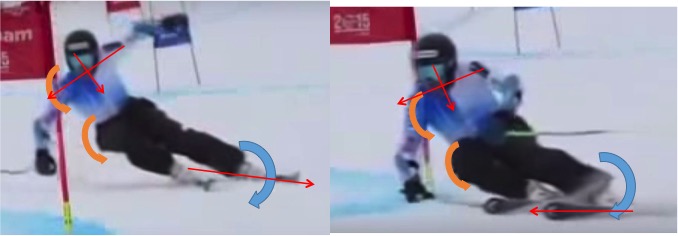
Since the skis turn on their own, the minimal action would be to rotate with the skis, so the counter is in fact a conscious effort. We rotate the upper body counter to the lower body in proportion to how much and how fast the lower body is turning to keep up with the skis, resulting in a somewhat stable upper body!
Get the skis on a green or blue run. Take off the pole straps and keep the poles in front of you, horizontally.
Turn left/right as usual, by tipping the skis from the lower body and compensating with the upper body.
But this time focus on keeping the poles down the hill. The poles should not rotate left/right nor tip left/right.
This will prevent your body from rotating with the skis and help create the counter you need.
.todo redo video poles-out-in-front
Take video and watch it in slow motion. Pick a few good turns.
- Did your shoulders rotate with the skis 100% or did they stay more facing down the hill?
- Did your hips rotate with the skis or did they stay facing more down the hill?
You know what to improve: go back and do this a few more times, take video and re-check. Do the Picture frame drill a couple times a day. It is really good!
Read more
Drills:
If you feel adventurous, try the Outside boot touch with a twist.
Posts and sessions:
- Lower body and upper body separation
- How much counter is good
- Carving and upper-lower body anchoring
If you don't get some improvement after this session, do the entire Coiling workout session. This is such a critical skill, you won't ever work eough on it ;)