Lower body and upper body separation
We turn with the lower body and use the upper body to balance. To ski well, we need to separate the upper body movements from the movements of the lower body - let's take a closer look at what that means.
Many beginners and intermediates are stuck because they don't realize that they're using the entire body to turn and there's nothing left to balance with. Higher speeds require more movement, which requires more balance and you can't create more balance when the upper body is used to turn instead!
When you use the upper body to turn, you are creating imbalance: unnecessary momentums and inertias that then need attention to control.
Lower vs Upper body
Think about walking: of course the point of waking is to move the big mass in a certain direction, but we do the actual walking with the feet and legs and aid with the upper rather than the other way around. The upper body is in charge with balancing and momentum.
Try it right now: stand up, flex knees a bit and tip on edge.
Now tip more!
You'll notice that as the lower body (knees, hips) moves more inside by tipping, the upper body has to compensate to stay in balance and you'll notice the shoulders tend to tip the other way.
Now increase the amount of tipping: you will see that the shoulders and the upper body have to bend the other way more, to compensate. We call this counterbalancing or angulation and it is a critical component of effective skiing. You will see later that it has a lot more benefits than just allowing an increased range of tipping.
That tipping of the shoulders the other way, to stay in balance, is perfectly normal. In fact encouraged. We'll have entire sections on this :) encourage it (it's called Counterbalancing)!
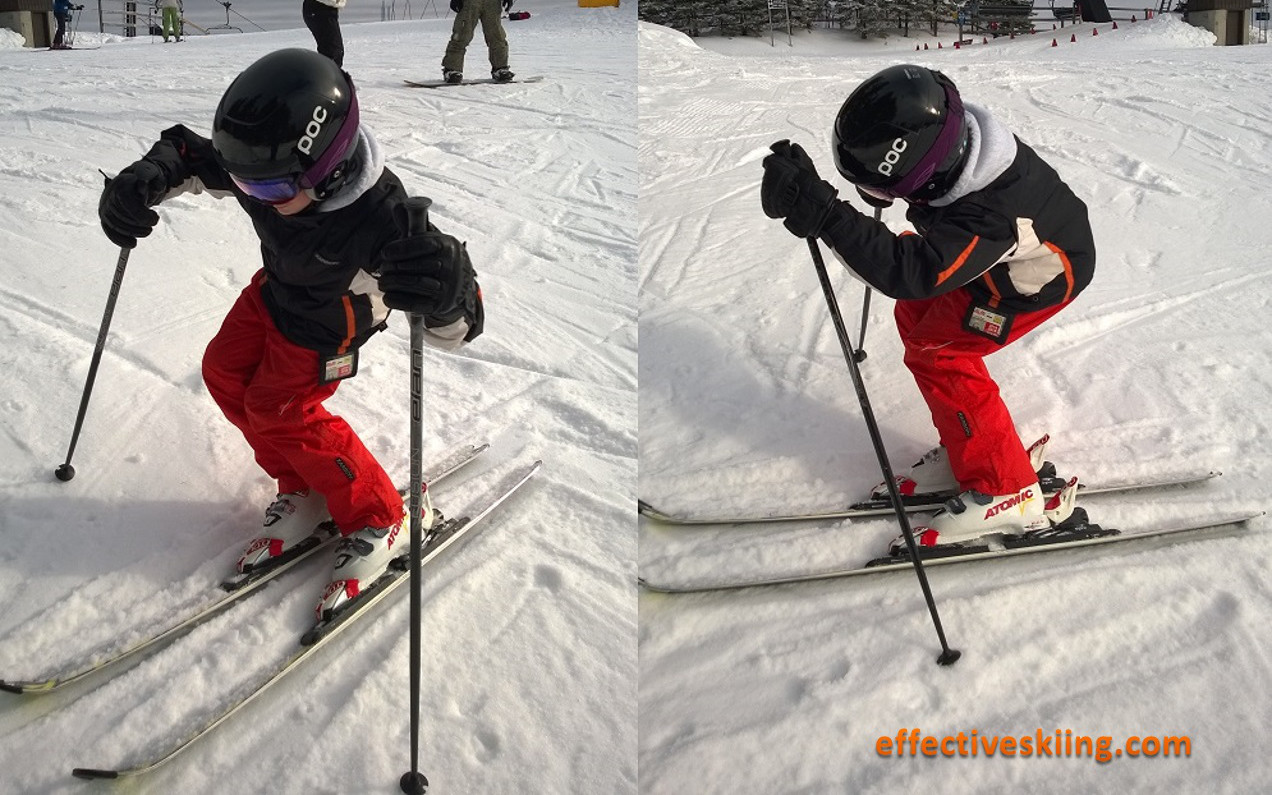
In skiing, the upper body needs to move in opposite and complementary ways, from the lower body. If the lower body is tipping on one side, the upper should tip the other way, to maintain balance and Alignment. If the lower body is turning with the skis one way, the upper body should turn the other way to compensate.
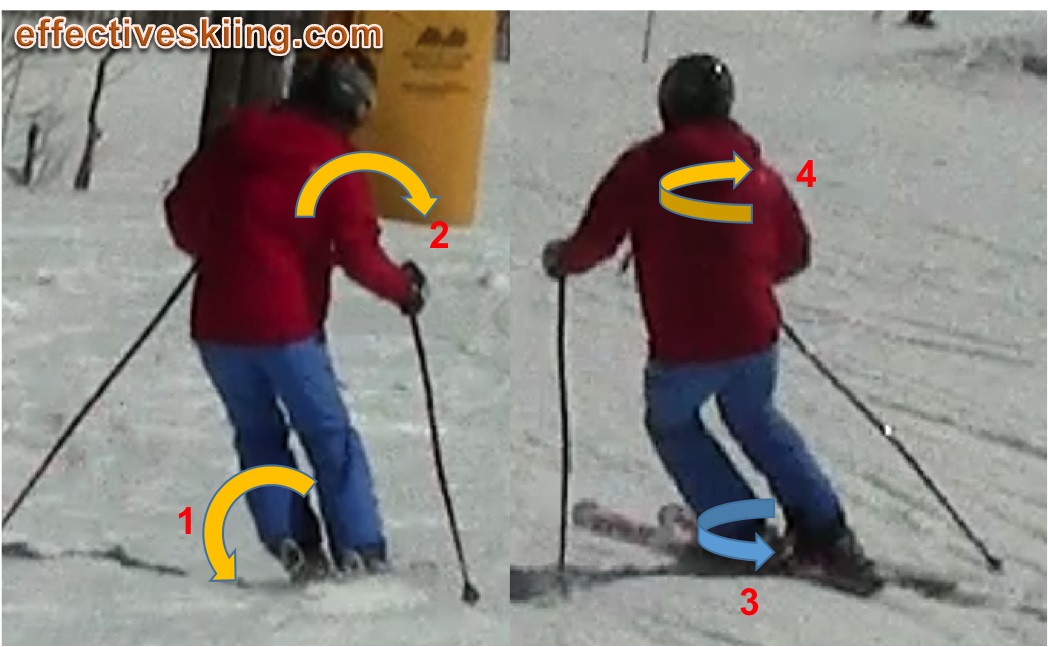
As you can see above, my legs are tipping and turning one way and the upper body is tipping and turning the other way:
- Tipping the boots to the inside of the turn (Foot Tipping)
- Tipping the shoulders to the outside of the turn (Counterbalancing)
- The skis are turning to the inside as a result
- Turning the shoulders to the outside (Coiling)
You can see how the upper body helps and complements the movements of the lower body. At low speeds, most of these complementary movements are automatic, like the shoulders tipping the other way to maintain balance, but some are not so automatic, you'll see as we start to explore the upper body movements.
Look below, this simple progression: at the beginning, there is no tipping and no balance. These are added towards the middle of the run and look at the difference they make:
Need to relax
From riding bicycles, you remember that in the beginning, you were really tight on the handlebars and as you learned to ride, you started to relax the grip and the body and that, in turn, allowed you much more flexibility and balance, leading to a much better riding experience.
Imagine gliding or skidding on ice - you will most likely again be all tense and locked up.
Skiing is the same. In the beginning, you're basically gliding and skidding on a slippery surface and will most likely have your body totally tense and locked up: all the muscles will tighten and in fact you will have a really hard time moving on the skis, because you are fighting your own body.
As you get used to it and the brain figures out it's not as crazy dangerous as it thought, the body will start to relax and loosen up and that will be a big A-HA moment.
To separate the lower from the upper body movements, you need to relax. You will maintain some useful even athletic muscle tension, but overall, try to relax.
This will be the first barrier to progress: yourself. The first step in dealing with it is to recognize it.