Hip dump
Expert skiers tip the skis on edge from the feet and ankles - many skiers though have a tendency to stick the hips out, drop them into the turn and help edging the skis that way - this is called hip dumping. It is not a good idea and usually indicates some problems with the setup and Stance or too many bad habits.
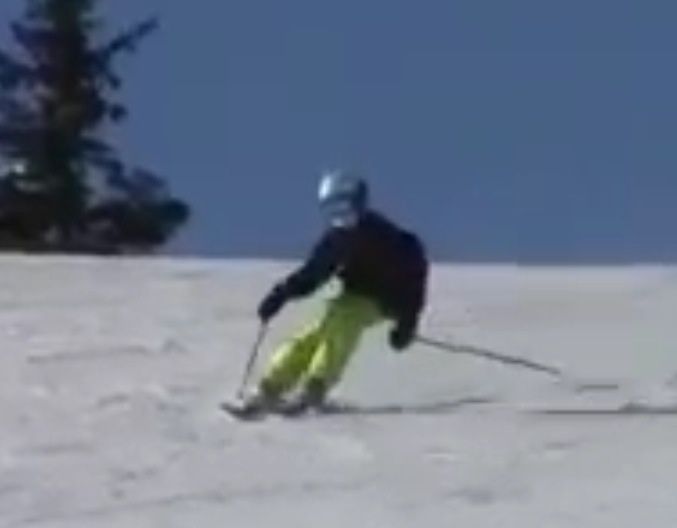
Some reasons for hip dumping, other than simply bad habits, are equipment related and these should be checked first:
- Boots too large
- Boots too tight
- Alignment issues
See Tipping not hipping for details on how equipment affects hip dumping and ideas on addressing it.
Inclination of COM
Sure enough, to have the skis on edge, the COM (i.e. body) must be lower and inside the turn, this concept is referred to as inclination of COM... so, if the hips need to be low and inside the turn anyhow, you may ask well, why does it matter how they get there?
It is very important! Performance skiing (as well as good skiing in balance) is driven from the lower body and complemented with the upper body. When you edge or steer the skis from the hips, similar to pivoting by counter-rotation and other upper-body driven forms of skiing, the skier is not in solid balance, not in contact with and in touch with the snow.
Note that at the high end of skiing, you will often see what looks like a lower hip at the apex, when the skier is at maximum angles, but that is not hip dumping - far from it. It's not a matter of a static final position, but of how the skier got there!

The biomechanics of high performance skiing are addressed in the topics at the black/expert and racing levels. See Hip on snow for high edge angles.
Put another way, hip dumping is when the hip puts the ski on edge rather than foot tipping. When the hip is the first to move into the new turn, dragging the skis on edge as a consequence.
Edging actions can be achieved by whole body inclination or by angulation. However, it is the fine-tuning movements in the ankle that, while impossible to see, may distinguish between the optimal edge angle and a less efficient edge angle.
USSA SkillQuest
So what?
When hip dumping, the hips (body/COM) are moving inside the turn too fast and/or too early. This is generally done with the hips on top of a long outside leg, as the skier's mass basically drops inside the turn.
It is ineffective because you're using the upper body to turn the skis rather than the feet and we established that's just not cool and you'll also have problems when the going gets tough like ice, powder etc as you have exhausted the range of motion available for balance.
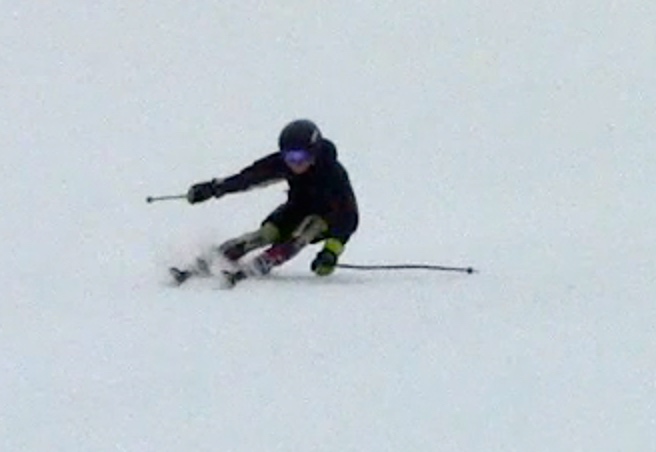
Same skier, a year later, still a slight hip dump, but not a major problem anymore, much better angles reached with tipping from the feet and ankles instead:
Most skiers use some form of hip dump - guess which of the two skiers below has the better initiation:
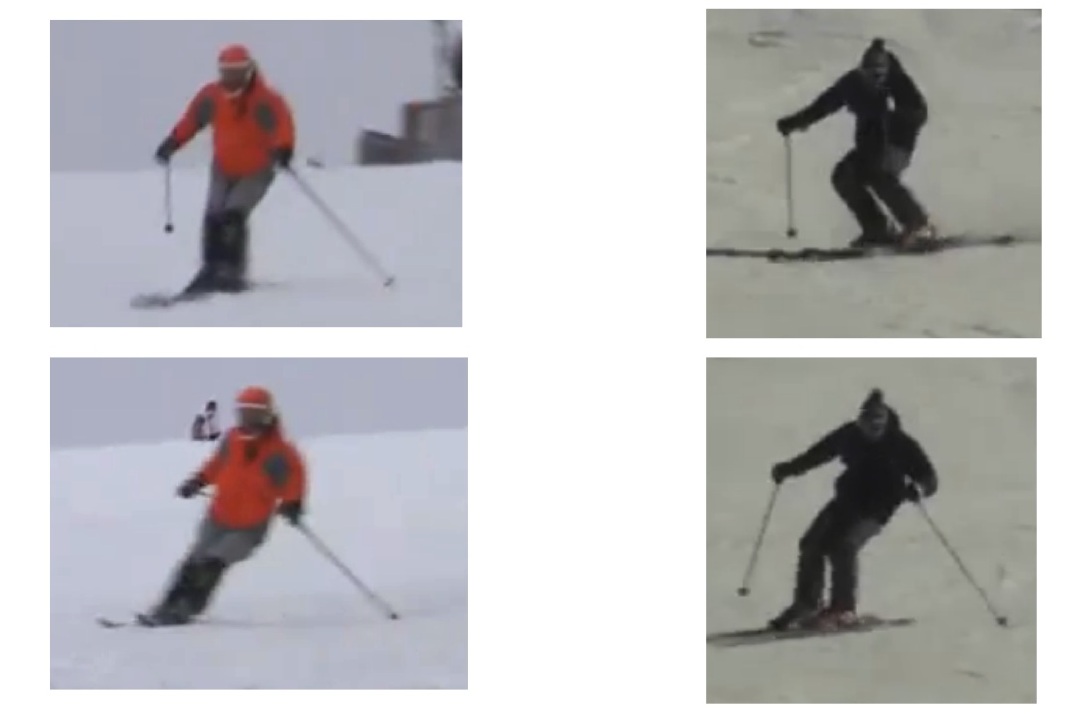
Here it is in action: the skier's movement pattern starts the turn with a hip dump on top of a long leg, i.e. the first movement into the new turn is to move the hips instead of using the ankles and that is what drags the legs and then the skis on edge. The sequence to look for is this:
- ending the turn and getting up
- extending the new outside leg
- lowering the hip, on top of the outside leg, kind of a "sit down" move
- that results in the outside leg creating angles
https://youtu.be/tB6ZSUjQ5xo?t=13s
Note that we do not endorse the instructions in this video!
That's hip dumping and is very different from foot Tipping. As you can see, hip dumping is also accompanied by Park and ride where the skier builds all angles at the beginning of the turn and just rides the skis statically around the rest of the turn.
Also, generally there is an A-frame as the inside ski is ignored and extra counter, to allow the inside hip to move in early. The outside leg also stays long, with no sign of Flexing. Another sign of hip dumping is shuffling the inside ski forward and exaggerated counter-rotation of the upper body, which allows the skier to both lower the hips into the turn and retain some lateral balance while doing so.
Biomechanics
To get into the biomechanics of performance skiing, there is one fundamental concept: Separation and, related, upper body discipline.
When the upper body is used to drive the lower body (as in hip dumping or hip steering or any such) there is no separation. What does this do? Impairs balance for one. The long leg connecting the hips to the feet lacks the range of motion required for balance adjustments on snow.
The other issue is that the upper body discipline is lost: the upper body is used to create momentum (angular or up/down) to drive the skis and once this momentum is created, the skier is simply a prisoner of this momentum.
To see this: try to complete 3m offset slalom carved turns, at 0.6 seconds per turn with a long leg or with a big up/down movement or hip rotation. If upper body movements was the way to do it, that's how technical events would be skied at the world cup, but that's not how it's done. Here's how it's done, the complete opposite of that (all lower body movements and disciplined upper body): here's Mikaela Shiffrin in training GS:
And here's Felix Neurather training Slalom:
These are both slowed down a lot, so you can observe the mechanics involved and the first thing to note is that the legs are never long in transition - so there is no hip dumping or hip steering involved, since that requires a long leg to connect the two.
Read more on Coiling and Counteraction.
Hip dump and angles
Another way to look at it, more visual: you are hip dumping in a turn if at any point before pressure, your hip is below the knee if you drew a line from the hip joing to the boot on the outside, as it is your hip leading the turn instead of your knees.
Here's a visual for that, together with more detailed biomechanics:
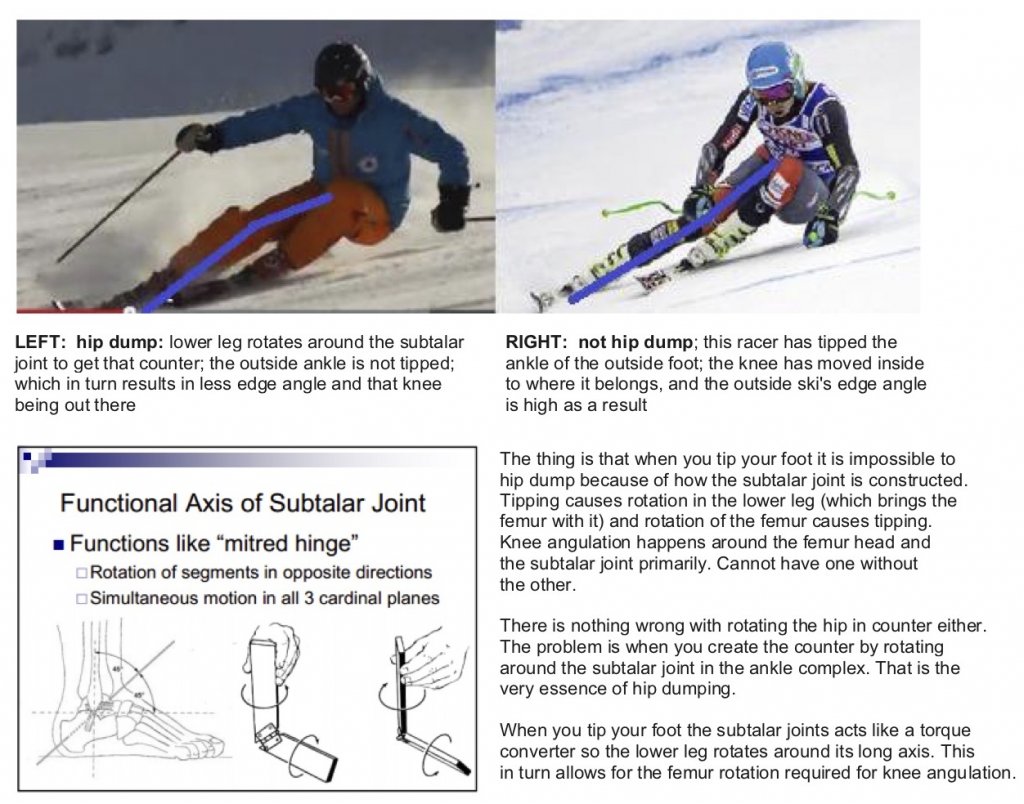
You can also see why hip dumping limits final ski edge angle, because it introduces an external rotation of the tibia, which in turn takes the ski off it's edge.
Notes for racers
Get fast-track to see this · $80/yr
Tipping sequence
Get effective to see this · $40/yr
See Tipping not hipping for ideas to addressing these issues.
More reading and references
Some useful drills and sessions:
- Tipping not hipping
- The inside ski
- The Phantom
- Rollerblades, Braquage, Garlands and Edge hops
- Keep your feet together
- Tipping and keeping the feet underneath
- About ankle eversion and inversion
- We ski with the feet and ankles
- Phantom Javelin
References:
- Various forum discussions
→ Start fixing your hip dump Start the specific progression to improve this skill!