Counteraction
While the skis are turning because of the other movements and interaction with the snow, counteracting is the active rotation of the torso contrary to the way the skis are turning, one of the essentials of skiing[^1] and how we create good Separation.
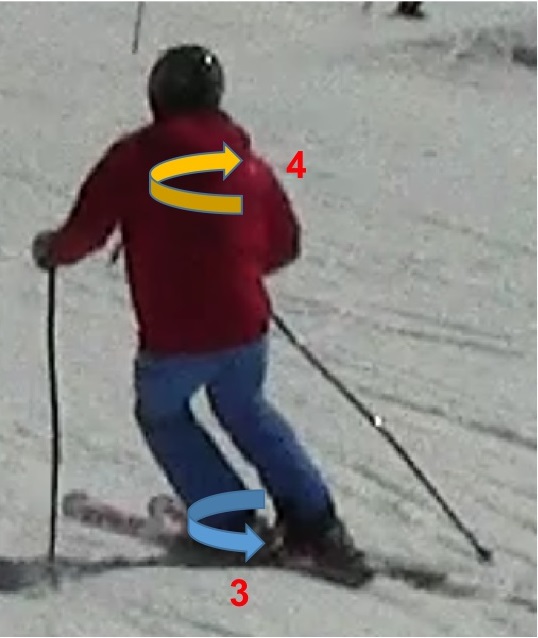
Related to countering and Coiling, counteracting is specifically defined to be based on the action of the upper body, not a passive result of Tip lead or a result of some active lower body twisting.
Some like to see separation as a passive notion, of either "skiing into counter" or "passive tip lead" or "the lower body turning under a stable upper body" but in performance skiing, when there is significant ski-snow interaction, separation is created through an active upper body movement: counteraction and coiling specifically mandate that the torso actively turn opposite to the skis.
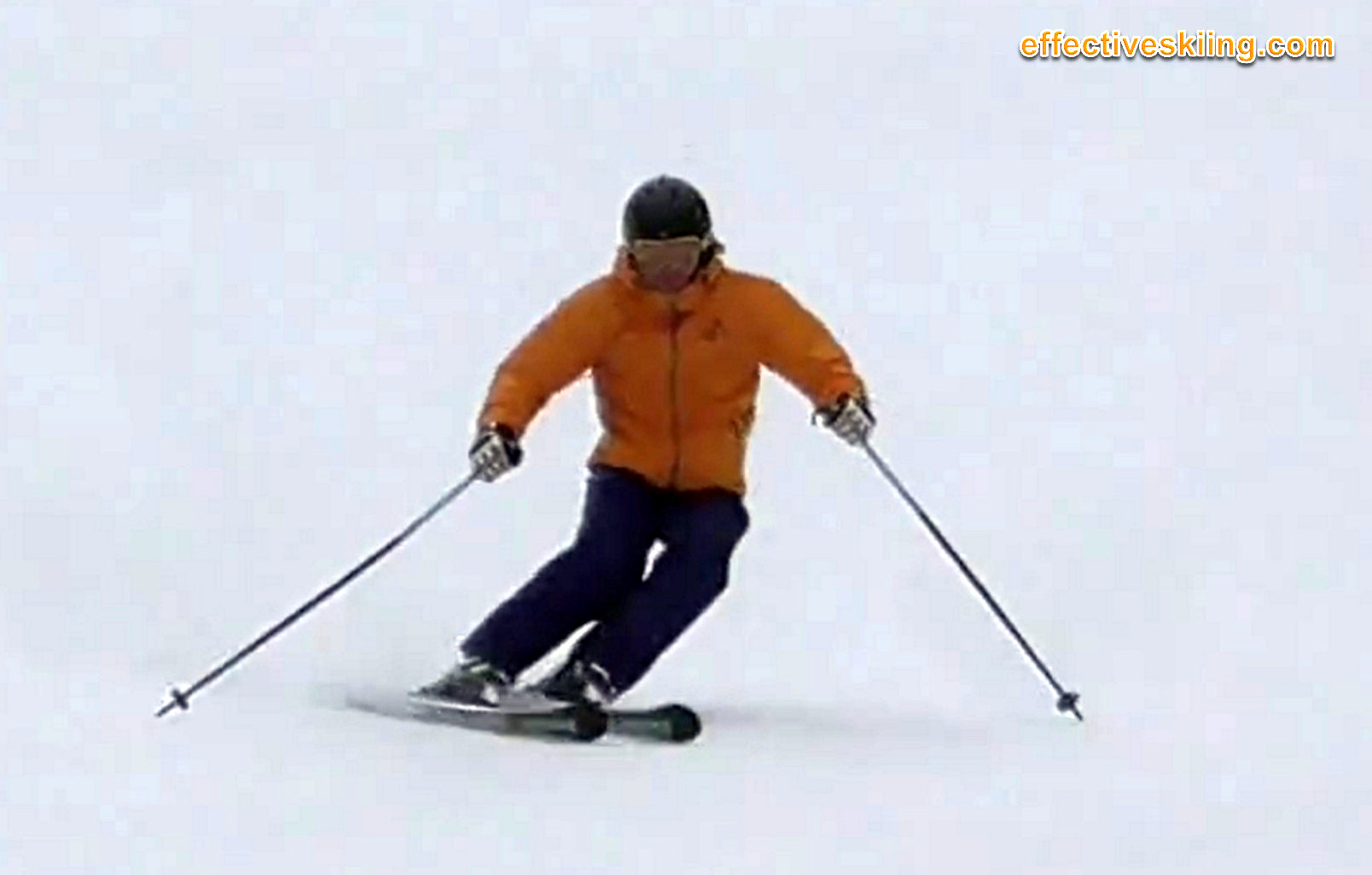
Counteraction is a component of good Separation of the upper and lower body and a fundamental movement of great skiing. Counteraction complements Counterbalancing as when you're countered, the slight bend forward at the hips also helps balance over the outside ski and these two movements combined throughout the turn, result in great balance and range of motion.
Do not confuse counteracting with counter-rotating... these are completely different actions!
Hips vs torso
Beginners generally focus on moving the shoulders to create counter, but it is better to focus on moving the hips. Good counteracting includes the hip, trying to minimize torsion on the spine.
You may sometimes hear of "letting the legs rotate in the hip sockets" or Femur rotation. That idea is related to counteracting from the hips but ties it to leg rotation. In performance skiing, due to the engagement of the skis in the snow, the legs are not free to rotate, so the upper body will need to counteract, instead.
Racing
The "static" look of the result, of the countered relationship between the upper and lower body, looks different in different situations: it is important to note that the actual movement matters, not necessarily the result. We counteract as needed, not in a prescribed amount.
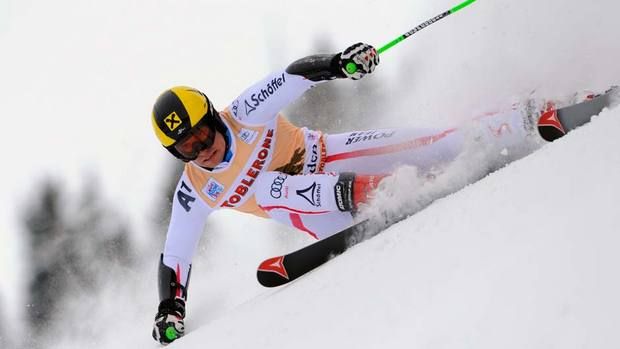
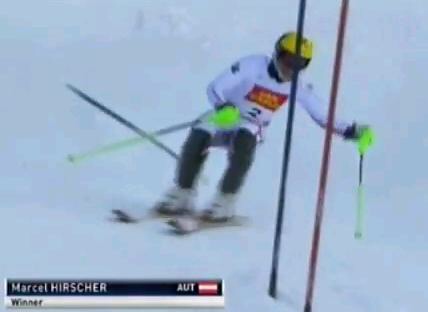
Note that in SL (short turns) we do not want any excessive rotation of the upper body - you can easily exceed in either direction (too little and too much). These extremes around the fall lines are specific to GS and longer turns. However, it is important to not rotate in Slalom also - you will see all great racers have a countered relationship in the fall line.
See also Coiling and Steering and coiling for more details.
Countering terminology
There are several terms encountered in ski instruction when talking about rotational separation, here is our attempt at disambiguation...
Separation is the general principle of separating the upper and lower body.
Counter or countered describes a relationship between the upper and lower body, at a point in time, as opposed to a movement. Maximum counter usually occurs at the end of the turn.
Counteraction is the action or movement that creates the countered relationship, through a specific upper body action, to rotate the hips opposite to and in proportion to the skis' turning. Coiling on the other hand is sometimes seen as a lower body as well as an upper body action.
Coiling is also generally used in racing circles, denoting a "strong" separation, involving more "energy" and "torque" than we find needed in average skiing.
While counteraction is a continuous movement, coiling is generally emphasized around the end of the turn, where the "torsion" is created, so counteraction seems to send the better message: we can say that counteraction is how we create coiling.
Counterrotation is the direct opposite of counteraction and it is a pivoting mechanism, generally considered a negative/fault, falling under the larger category of turning with the upper body. For instance: "the action of upper and lower body turning against each other"[^2].
Pivoting the femurs in the hip sockets is another action or movement that creates the countered relationship, by rotating the femurs into the turn, "under a stable upper body".
The differences are not just about philosophy and point of view as to what the skier should focus on - the action on the snow is quite different. The femurs will always pivot in the hip sockets, for good separation, around several axes, the question is why? Is that a result or an action? If the desired result is pivoting the flat skis, then the focus could be on the femur pivoting while the hips still rotate to the outside. If the desired result is solid carving, then focus could be more on edging while counteracting the hips.
In fact, focusing on rotating the femurs generally leads to pivoted turns, while a specific focus on carving more will lead to counteracting, see Femur rotation.
The counteraction movement starts early in the turn and continues throughout the turn, while the coiling and/or countered relationship between upper and lower will appear late in the turn.
Anticipation is an older term, not really used anymore, to denote the same notion of counter.
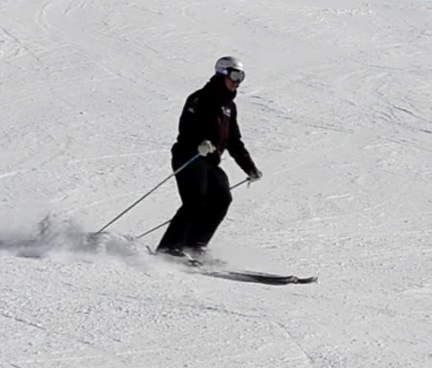
Rotation is the lack of counteraction, as in allowing the upper body to follow and turn with the skis:
Timing
Counteraction is done as compensation for the skis' turning. This means that the counteraction should be done throughout the entire turn, rather than specific points in the turn.
Movements | discussion
Sometimes the result, the countered relationship between the lower and upper body is described as a result of the lower body turning "under a stable upper body", or sometimes Femur rotation and/or steering. This may only be true in very short turns, where the body's inertia/momentum provides some "anchoring".
But in all skiing, the upper body will have the tendency to follow the skis and rotate with the lower body, since the two are strongly connected at the hip! We prefer to see the lower body turn because of the interaction with the snow, however, and the actual movement we can do to create this countered relationship of the lower and upper body is then by rotating the upper body opposite, aka counteracting.
When the skis are on edge, your lower body is anchored, rather than the upper body. Turning the feet into the turn has a completely different meaning... we are not even free to rotate the lower body to create counter, since it's locked by the skis' engaged edge and it is a prisoner to turning at that precise rate that the skis are turning. If you try to rotate it any faster, it would have an effect to dig the tips into the snow even more and washing out the tails. It would leverage the snow and help the upper body counter even more: action and reaction.
See Skiing - a philosophy of movement for a detailed comparison of the different movement frameworks.
Bottom line: we do not see the counter and separation as a result of some passive upper body anchoring, but the result of a concious effort of the upper body, to counteract the turning of the skis, so it appears stable!
Advanced counteraction
Get expert to see this · $60/yr
Holding the counter
Get expert to see this · $60/yr
Why counteract?
See Separation and ski performance.
Read more
Related posts:
Sessions:
- Intro to coiling
- Upper and lower body separation again
- Explore coiling
- Strong inside half
- The coiling contortion
- Refine uncoiling
Drills:
→ Start improving your counteraction
References:
- Essentials of Skiing, p139 [^1]
- CSIA Skiing and Teaching Methods, p25 [^2]