Separation and ski performance
I just saw a video from a top coach, trying to answer the question "what is the role of separation in ski performance" and, while it addressed some important issues, it left me wondering... as to what the answer was - some seem to excel at using a lot of words to not say much about a technical subject...
Counteraction is the performance enhancer! HeluvaSkier
So I went back and reviewed our material and sure enough, many reasons and relationships are explained and practiced in a fine level of detail throughout the progressions and articles here, but not captured together in one single page - let's make this that page.
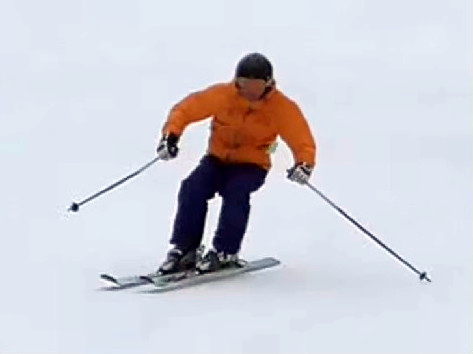
Balance and range of motion
The most important principle of good skiing is balance. Balance is achieved via a range of motion: the bigger the range of motion available, the more disturbances we can deal with... of course, there may be some practical limits to that, but let's not get lost in the weeds!
For instance, lock up your knees and jump up a little (from the feet). CAREFUL: this may actually be a painful experience - so maybe just think through it rather than doing it, but that discomfort is actually the point. On landing, you'll be jolted quite significantly and some discomfort or outright pain may ensue! Why? Because the knees were locked and some body parts could not separate one from the other, to absorb this shock! The only reason you're still standing in relative balance is that the shock was in the direction of the locked up joints! If the shock was sideways, we'd fall!
And that's the crux of explaining separation and balance. Separation of body parts simply enables and creates balance, by providing the ability for the body parts to move separately from one another and absorb shocks from more directions than otherwise, via an increased range of motion!
Another aspect related to separation and balance is that when body parts are free to move and act independently, one will not affect the other too much. Think the feet hitting a bump but you relaxing the legs and allowing the knees and hips to bend and absorb the impact!
We prefer to think of separation as a general principle of separating body parts - but usually, it's about separating the upper body from the lower body, and this separation is lateral (angulation, Counterbalancing) or rotational (counter, Coiling).
Stacked apex
Stacking the skeleton properly at the apex is a common cue and explanation for how counter helps one ski better.
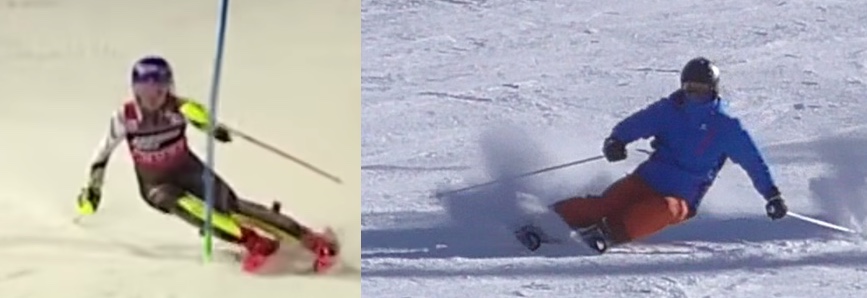
While some skiers gide haplesly around long turns, as performance skiers, we prefer to bounce from apex to apex! The apex of the turn is the point where we "hit" the ski with the most lateral force and if we have no separation, it would be pretty much like that exercise of jumping up and down with locked knees!
Believe it or not, but locking up square and inclined into the turn is not the strongest alignment to resist large forces! A bit of rotational separation or counter helps line up more of the skeleton over the outide ski, which is the one that matters - so that's number one. At the same time, the slight coiling allows more forward bend at the hips to be used for lateral balance - think about it! Not to mention that having that bit of separation will allow us to better support any issues like the ski sliding out or hitting a rut or any balance challenge like that!
Slicing the bottom
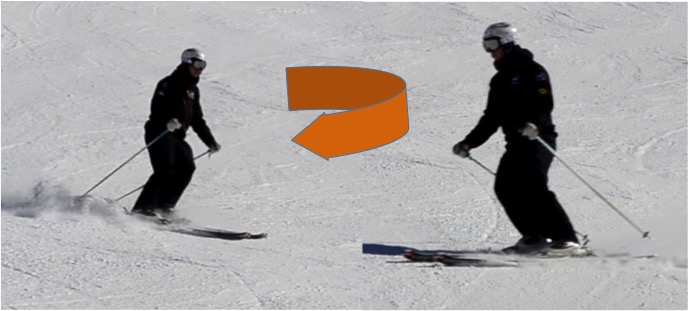
Another important role is to keep the ski slicing and carving through the turn and especially the bottom of the turn.
If we rotate with the ski, the tails will washout. This is very familiar to any racer and coach and high-performance skier!
Get fast-track to see this · $80/yr
Open Hips
Often refeed to having open hips - maintaining some counter in tra sition helps with both moving the upper body into the new turn as well as better range of motion for tipping the feet into the new turn (together with some flexion).
Fore/aft
The last element of coiling we will look at is the relationship, in high performance skiing, between counter and fore/aft.
Get fast-track to see this · $80/yr