Flexed release
Flexing and shortening the outside leg in order to release the ski, also referred to as "flexion release", "flex to release", "retraction" or "down-unweighting", is an effective method of releasing the outside ski. These movements reduce the weight on the outside edge, allowing it to be released and un-tipped (to flatten the ski), as the turn ends. During transition, both legs are shorter rather than longer, a result of this flexing.
The flexing and shortening the leg to release will avoid an excessive up and down motion of the body and also, allows the skier to retain maximum control over the skis, by keeping them in contact with the snow (or close enough) and in fact, most releases include some flexing of the outside leg. The opposite type of transition, by extension or hopping up tends to disconnect the skier from the snow and delay engagement in the next turn.
Here's a good intro and contrast to other releases, from Reilly:
Get effective to see this · $40/yr
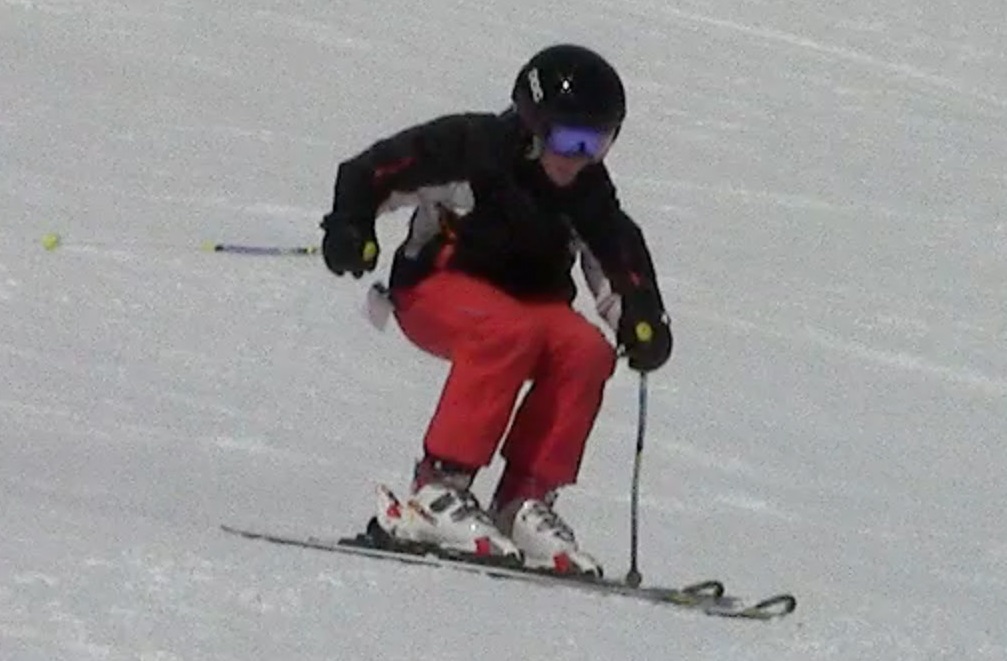
Flexing to release results in a typical lower stance during the transition, as you see in the rather extreme example above, which will also result in what seems like a very aft position on the skis, requiring a strong recentering and coiling, like below.
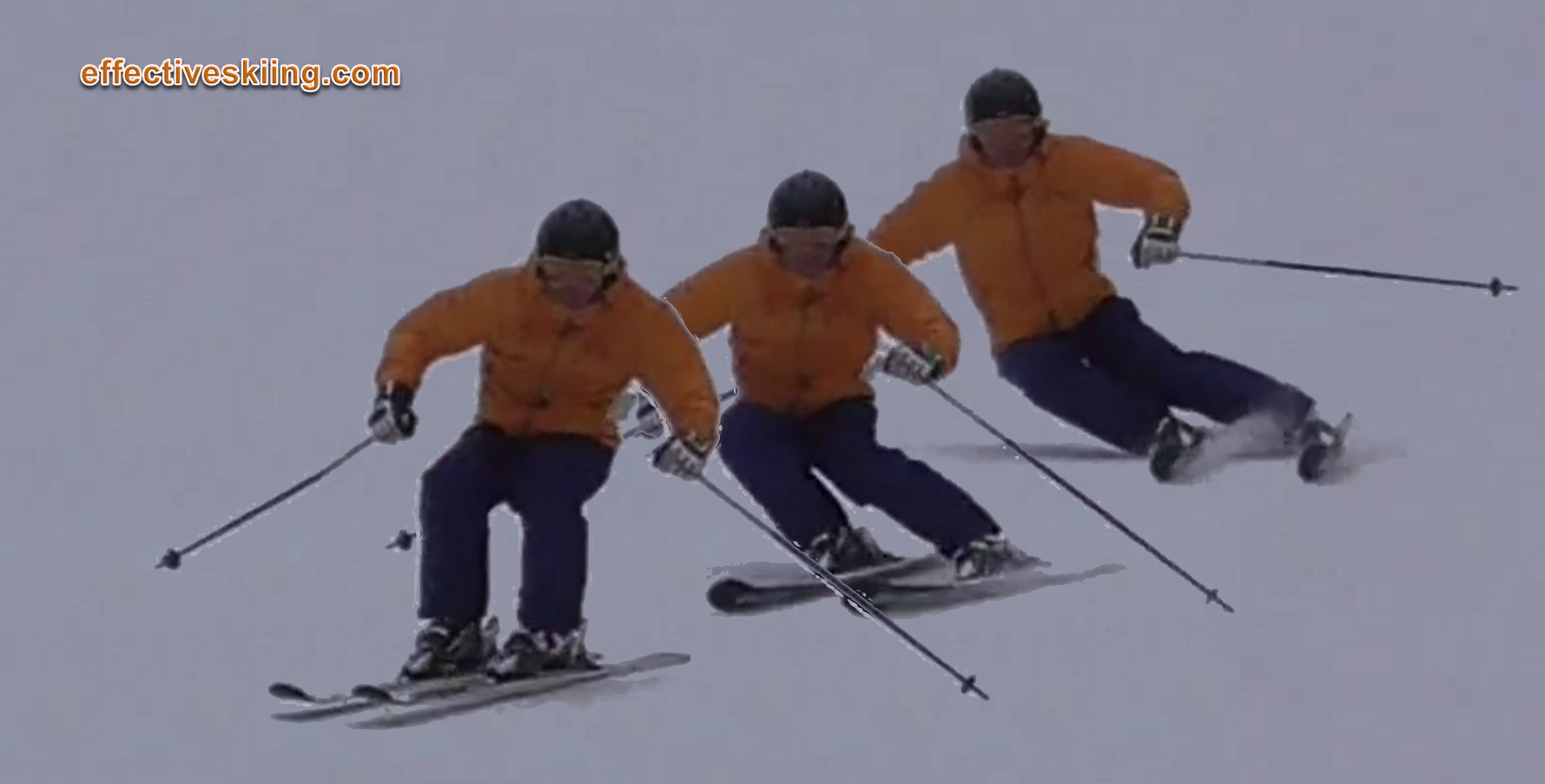
This type of release is very good for absorbing the energy of high performance turns, as you can see here - even with that deep flexion, the skis still come off the snow:
The flexion is normally followed by tipping and an extension of the new outside leg into the new turn, where it allows early tipping of the skis into the new turn, as you see below dynamically, in slow motion:
Biomechanically, flexed joints allow mobility and separation, this is a big reason behind the efficiency of the flexed release.
An extension or push-off by contrast does not allow early engagement of the skis at the top of the turn, as the skier's hips would be "too high" and disconnected from the snow, especially in short technical turns!
Other benefits of flexion include establishing early "inclination" into the next turn, as the hips are lower and we don't have to "wait" for the hips to come down from a high position, we just extend the legs into the new turn and quickly establish inclination at will.
Debate
Releasing the ski via flexing and shortening the outside leg, or down-unweighting or retraction was (still is?) a hotly debated topic, ever since Joubert's book presenting avalement but it is so prevalent in today's top skiers that a debate is moot, see Low in transition.
If not done properly, the flexing will induce some artifacts (like being back, squatted with less range of motion etc) which the skier needs to know how to avoid and deal with. This is why many coaches don't coach this movement, because they don't know how to deal with the likely side-effects which will appear as soon as they start working on this. In turn, they're happy to allow it to appear in some strong skiers, which discover it "via luck". Many other skiers do not discover this, so we think it's much better, overall, to educate coaches and learn how to coach it effectively.
Relax to release
The most important part of this type of release is the flexing and shortening of the outside leg. The long leg will flex when relaxed or retracted after the high pressure at the apex. Sometimes, a strong retraction is required, that is an extreme case, we can call that retraction. It is common in bumps and other situations where the skier has to react fast.
The flexion and absorption of the forces of the turn also provides another benefit: it is smoother and easier than a hop or a hard hit and also more relaxed and takes less effort. Although quite a few skiers find it tiring in the beginning, that is also common, as skiers mis-time the relaxation until "getting it".
Hips move higher
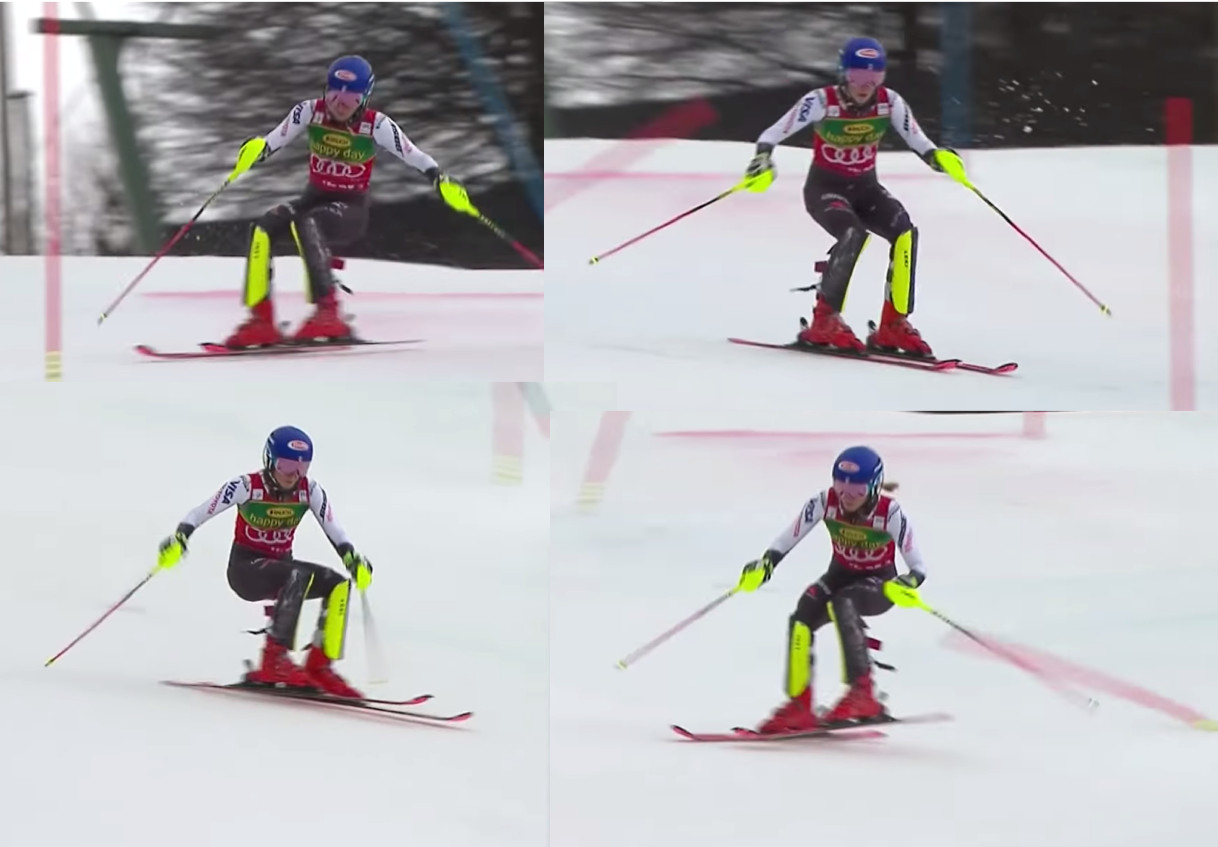
In the release below, the body is not impulsed "up" much but the hips still come higher in relation to the boots, because they were very low to the snow at the apex (the hips actually stay more or less level while the boots move further down the slope, if you look at how the slope influences the geometrical relationships below):
So, when looking at a skier releasing, it is better to look for extending legs (long or getting longer), or legs that stay the same, or legs that get shorter (flexing), to determine the release type and how the body is impulsed. In the release above, notice how the outside leg is long at the apex and relaxes and becomes short (bent or flexed) when the skis are flat on the snow.
In Ted's release below for instance, the leg shortens just the same but the hips do not actually come any higher - this is simply a matter of timing (when do you start to shorten the leg? before or after the hips got some impulse up?) and of the slope - above we have a flatter slope while Ted is on a steeper part of the course, so his feet drop fast enough so the hips do not rise anymore.
This part is not that relevant, the fact that the hips do come up no matter what - of course the hips come up in relation to the snow: if you're a decent skier, your hips are on the snow at the apex and you'd like them, for safety reason, to be generally above the knees when the skis are flat, so of course you allow the hips to come higher.
Did you push them higher on a flatter slope? Did the steep slope fall away from you very fast, so the hips remained at the same level but are now higher from the snow? Not that relevant! What is relevant for performance skiing, is retaining the ability to contact and pressure the snow at will, which only works if the hips are lower than maximum extension and if the knees are bent (the more bend the more range of motion, until some threshold of diminishing returns, say around a 90 degrees squat).
Range of flexing
There is a range of movements between passively relaxing the legs and allowing the energy of the turn to push the boots up OR gravity to pull the body down. At the other extreme we have a full retraction, where the boots are retracted towards the body.
Some of these may be referred to sometimes as "down unweighting" and in the extreme case, retraction release, when there is a strong retraction of the boots.
The extreme ranges of flexing or retraction shown here enable high performance skiing, but in reality, the range of flexion will depend on terrain, turn shape etc. As a matter of principle, however, any flexion during the release is better than none and leads to better, smoother skiing.
Speed control
Retraction releases usually interfere with speed control. Speed control when using retraction releases is a higher level skill (we cover that at the black levels).
Down unweighting
This type of release is also referred to as "down-unweighting" and contrasted to "up-unweighting" aka the push-off, where the hips are pushed "up" to unweight the skis.
We prefer the description relax to release because it is very specific as to what the skier does and it does give us a better image as well as a better cue while working on our skiing.
The gray area
Between a full extension, or "hop and over" transition and a pure "flexed release" there is a large gray area which causes much discussion and confusion.
For instance, some may consider the 4th release in the sequence below to not be a "flexed release" although the knees are clearly bent and the leg clearly shorter than at the apex:
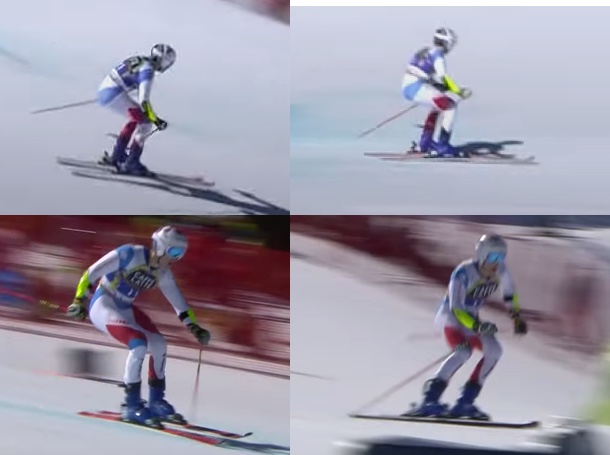
In our mind, that's clearly a relaxed and flexed release, the only difference from the others is that Odermatt managed to get a useful impulse forward in the direction of the ski, just before relaxing and flexing the leg.
Are all transitions where the legs are short when the skis are flat, are all those "flexed releases"? Most are, that is the signature of a flexed release, short legs when the skis are flat, but some are not so black and white. There is some gray area there, where the skier may actually push a bit into the skis and then relax. We call that "juicing" - see this turn from Marcel's free ski run and contrast that particular release with the others in that same run:
At time mark 1:21, that release looks somewhat different than the others, he looks undecided and just tips over while the leg stops relaxing at some point. That's part of that gray area: did he flex the leg? Of course! Did that release the ski? For the most part, yes, because the force was reduced a lot with this flexing. Is that a pure/clean flexed release? Not quite, because the ski was not really released before changing edges, there was a bit of weight there.
Anyways, for our purposes, we contrast the flexed release with the "hop up and over" so we consider all these to be "flexed releases". Some are better and more black and white, while others not so much! Such is skiing - color is everything!
Another sequence is quite common, which includes flexing just a little to end the turn, then extend before changing edges, but not quite go through transition with long legs. This is closer to an extension, because you go through the transition with a net impulse "up" and there was a push and extension somewhere in-between, so I would not consider that movement pattern to be a "flexed release", at least not a clean one. For instance this video - good skiing and although there is quite some flexion to end the turn, if you look closer, it is subtle, but the movement pattern that actually releases the skis is a small extension, this is fairly common:
That pattern, flex-extend-flex, is called "flex to end the turn" as opposed to "flex to release" as the extension disengages the ski, not a pure flex to release. And you can contrast that subtle hop, with these clean flexed releases that Marcel shows in most of his turns, freeskiing or racing:
Or racing, where he switches gears from just a relaxed flexing to more of a retraction release, to keep up with the rythm (retraction relese is the same mechanics, wiht the addition of a strong retraction effort, after the passive flex - same pattern, different muscle activation):
And there you really have it: while there are many variations, some good, some not, it's all about the dominating movement pattern during the transition. What started the release process, what caused the ski to release etc.
Biomechanics
Effectively, as you will see throughout this website, flexing and tipping always go together, as you cannot have one without the other.
More biomechanics
This type of release has many biomechanical advantages. The flexion of the knees contributes to good separation of upper and lower body.
It also allows the feet to work independently from the hips and upper body and allows the Inversion and eversion of the foot to occur without implicating the entire body.
When working on flexing to release, the biggest drawback is that it tends to put the hips behind the boots, as you can see in the photos above. You need to improve your fore/aft as well, specifically by pulling the boots back. This is a more complex discussion, see Forward is down.
Read more
Sessions to work on this skill:
- Relax to transfer weight
- Flex to transfer weight
- Release untip to skis flat
- Recentering in fore-aft
- Increase range of flexing
- Flexing and extending
- Flex to release
- Forward is down
Drills:
- Sitting on a toilet
- Touch the outside boot
- The power release
- Ski Drill - The Penguin
More to read:
→ Start improving your release
Articles:
- USSA GS Technique and Tactics
- Tom Gellie has a good presentation on releasing: flexing to release.
- Anyone can be an expert skier 2, p79 [^1]