Recentering
At the end of the turn, the skis tend to "get ahead" of the body and we need to "catch up to them". Recentering refers to getting back forward on the skis, in the transition.
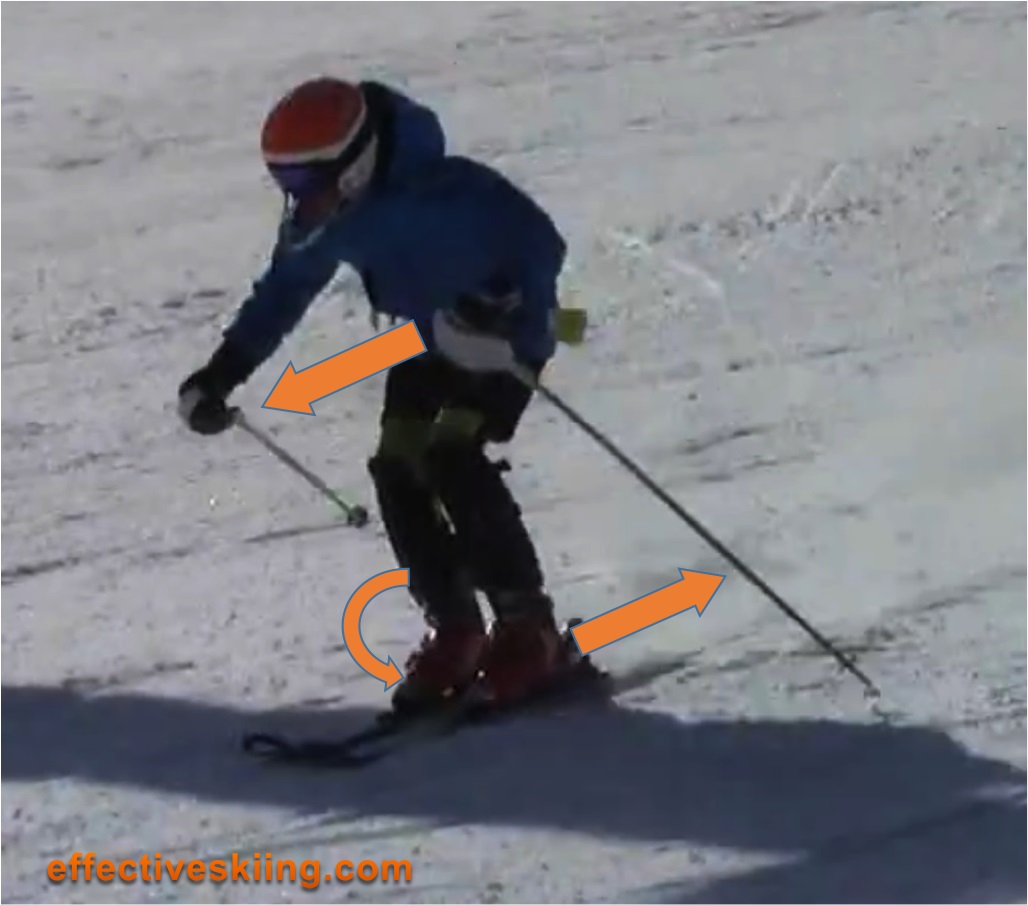
The basic need in transition is to get back on top of the boots, to start the new turn centered and with sufficient weight on the tips of the skis for the desired performance. At the high performance levels, we need to move the upper body ahead of the feet (i.e. the hips in front of the boots), in the line of travel and toward the apex of the turn[^1].
You get one shot at affecting being forward and that's when you're light in transition. HeluvaSkier
Depending on how and where the skis are released, we can get the hips ahead or on top of the boots by pulling the boots back and/or pushing the hips forward (make sure to read about Early pressure). Floating in transition makes it easy to pull the boots back[^2].
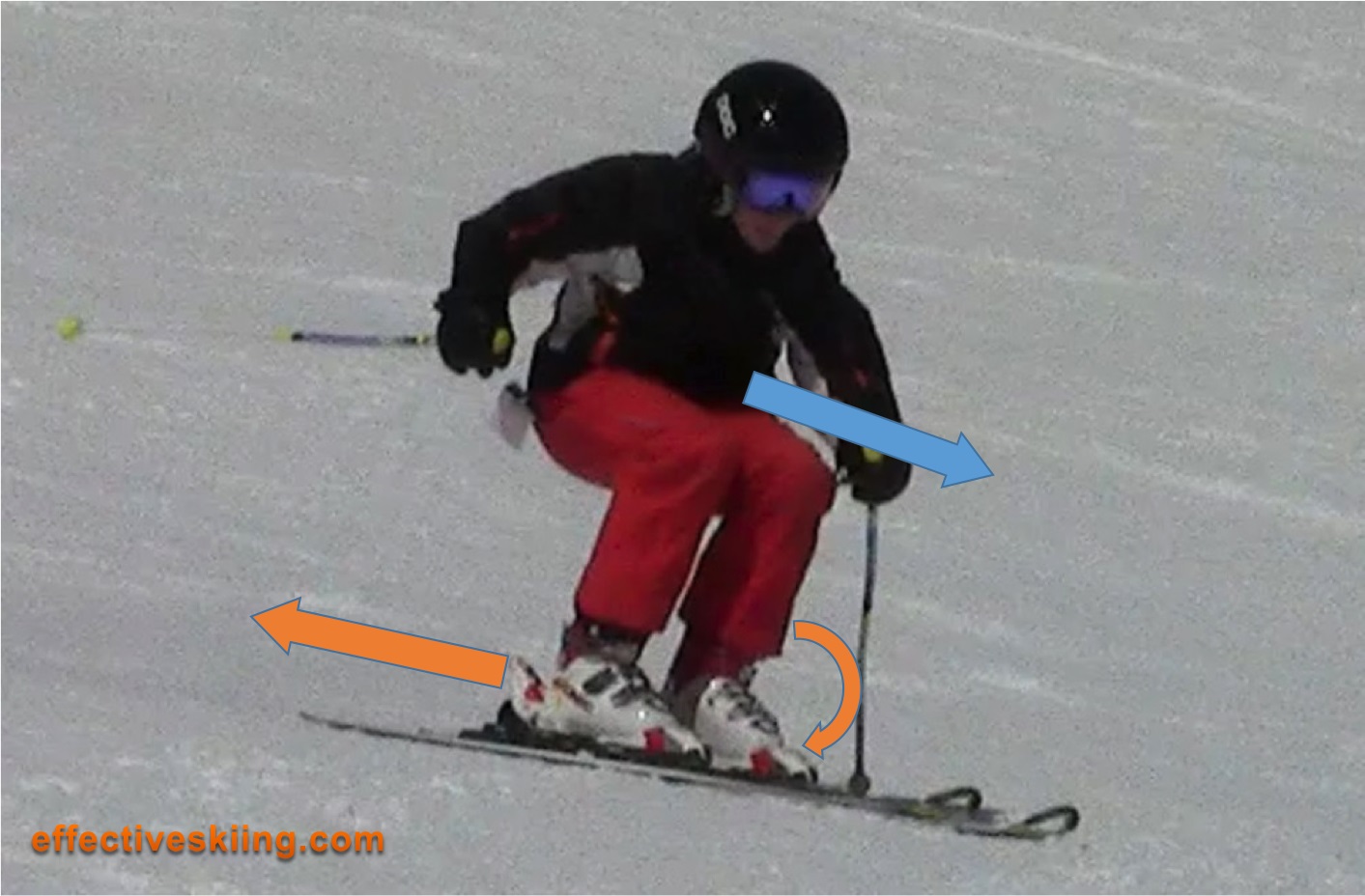
You can see above, since the skier is light and “floating” in transition, the active movements with orange are Dorsiflexion and keeping the heels back. The passive (in blue) outcome will be the hips moving forward relative to the feet, as the legs extend into the new turn.
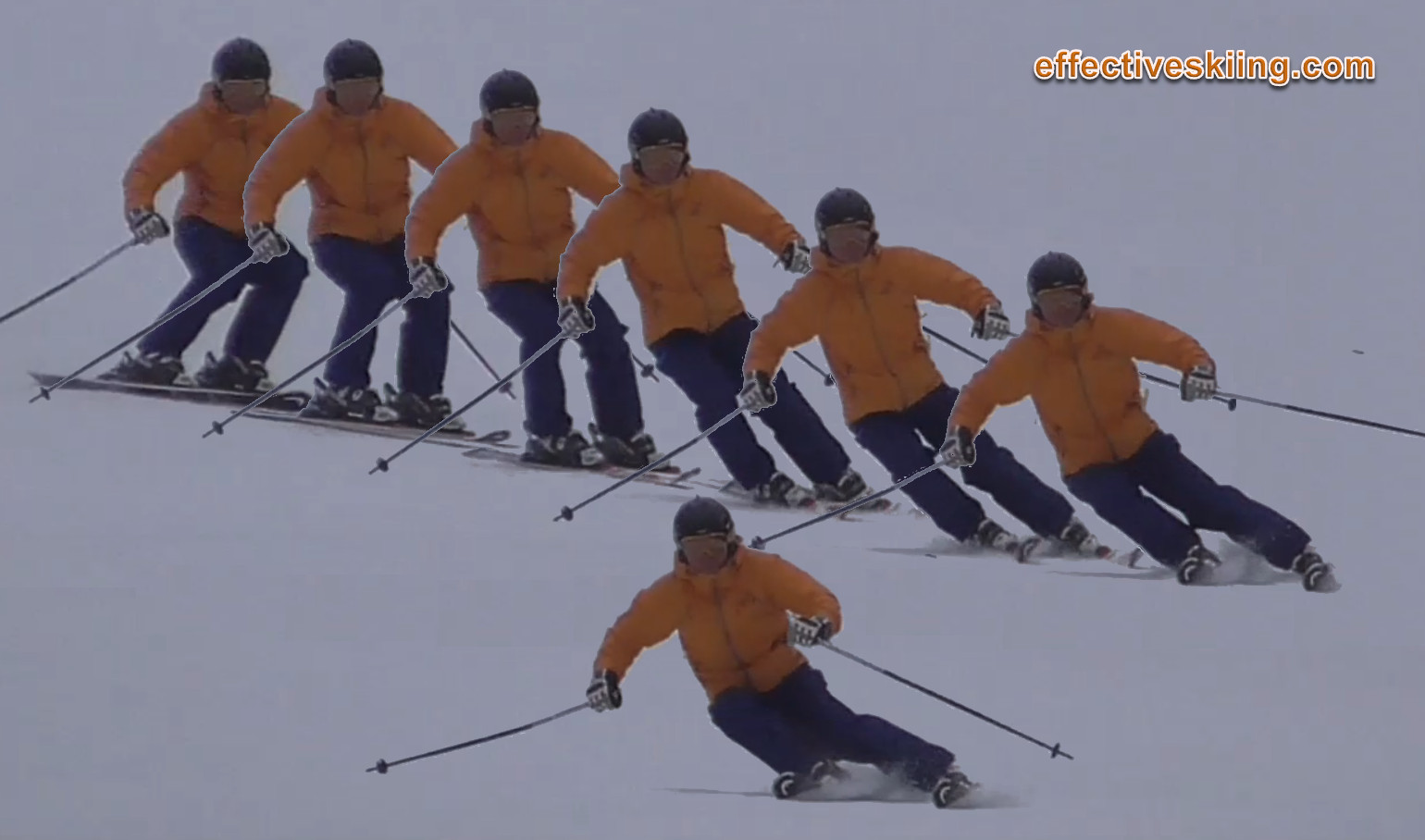
A strong, forward pole plant is also used to aid in recentering, in performance skiing. Double pole plants help as well, when the going gets tough! Other components that play big roles in recentering are angulation and Counteraction, as recentering is not just a movement along the skis length, but also across the skis - frames 2-3 here:
How?
Dorsiflexion (i.e. closing) the ankle is a major component of getting forward. This will bring or keep the skis back and/or hips forward and allow boot shin contact.
Other movements that contribute to getting forward are:
- pulling or keeping the heels back (with the hamstrings)
- extending the knee and hip (extension of the new outside leg) will place the boot behind the hips and/or bring the hip forward in relation to the boot, as a passive result
There are countless choices, variations and combinations of these movements, as well aided by the upper body when needed.
Good racers frequently adjust leverage and pressure distribution by sliding their skis forward or backward under the center of mass.How the Racers Ski p39, Warren Witherell, 1972
Another movement that aids in recentering and maintaining fore/aft balance is pulling the inside ski back in transition and continuing to pull it back throughout the turn[^2]. This also enhances Tipping.
Pushing the hips forward
Many skiers focus on trying to recenter by pushing the hips forward. That is of course possible: co-contract at the hip and knee and flex/close the ankle - it will result in the entire upper body rolling forward and the hips getting forward. Then, just extend at the knee and hips and it will bring the hips forward.
One issue with that is that we tend to push in the heels and that tends to result in pressure on the tails of the ski... which is not a good thing to have just as we try to start carving the skis with the tips... Of course, they also launch the big mass of the body, setting it in motion (or adding to the momentum, since you were not stationary) which is both much slower and more prone to making mistakes and overshooting (big mass, big muscles etc).
It is quite customary to use this method at the lower levels, where it is combined with vertical movement (the extension/push). Read Low and forward for a larger discussion.
See Recentering in fore-aft and Keep your feet underneath you for details and learning sessions.
When?
In transition. The movements can start as early as the release of the previous turn, which is the one that we use to impulse different body segments.
We should be careful and watch out for Early pressure - as pushing too early into the skis is not great timing - for instance a late "push" to get the hips forward, may negatively impact the next turn.
Racers are generally keen to "steal" as much lateral momentum from the previous turn as possible, to get across the hill - this is when the hips can be impulsed to move forward into the new turn.
How much?
Just how much should we recenter? It all depends on the next turn, the situation, snow condition, desired turn shape etc. From a green relaxed skier which needs a very subtle movement to stay on top of the boots, to a World Cup racer taking tight turns on really steep ice.
Remember that we do not need to flex the boots to be in a good centered/forward stance. We may need to aggressively use the boot cuffs in the turn, but to just recenter, the presence of pressure on the cuffs is a good sign, if the boots are properly setup.
If you look above, one important thing to note is that red pants has no other means to push the COM forward, as the skis are off the snow, so there's nothing to push against. All he can do at that point in time is to keep pulling the skis back.
The hamstrings are used in both scenarios, but less in the first case, as there is less leverage with the legs straight.
Because of that, blue jacket compensates with other muscles, higher up, which results in locking the hips (you see he is a lot more square to the skis than red pants).
On a tactical note, if you'd rather start the new turn extended, then blue jacket is a good example, while if you'd rather start the new turn with more flexion (yes, you should, for more performance), then you need to focus on pulling the boots back. See also:
Sessions and talks:
- Intro to recentering
- Recentering in fore-aft
- Exploring fore-aft
- Keep your feet underneath you
- Forward is down
- Getting forward
- Fore-aft and pressure
Drills:
→ Start improving your fore-aft
References and good reads:
- CSCF Canadian approach to ski racing [^1]
- Essentials of Skiing, p24 [^2]
- HeluvaSkier
- Epic discussion - Staying forward for racers
- How The Racers Ski, p39-40 [^4]