Factors that determine the ski behaviour
If you remember that the ski we're interested in, is a slalom ski designed for short turns and it will have a big sidecut and are shorter, you can safely skip this section. Read on, if you're interested on a more detailed look at several types of skis and the factors that determine the ski behaviour.

Ski shape (sidecut)
The shaped skis are the best for learning technique and conquering the "piste". These are usually marketed as "on piste" skis and are narrow underfoot and with wide tip and tail for a more or less massive Sidecut - a ski designed for short turns (usually a shorter length as well) will have a huge sidecut while a ski made for speed will be more straight (so it turns much less when put on edge).
There are also "fat" skis which are quite wide in the middle, designed to float on powder - these have a smaller sidecut shape, if at all, since they are not made to "cut" hard snow but really just to float on powder - a heavily rockered ski without a big sidecut will not bend as much (or at all) when tipped on edge on groomed hard snow - which is why we use big sidecuts and lots of camber for learning on piste:
There are a lot of in-between skis as well, which would be fatter but with some shape, sort of the "all rounders" which some say are bad at everything, heh.
As a beginner, do NOT buy a fat/wide ski (more than 80mm underfoot), unless your house is at the top of a mountain and you commute to work on powder year round, while your ride back is a helicopter. Ok?
Stiff versus soft
A stiffer ski usually has more metal layers inside it and will be harder to bend into the desired arc, while a softer ski is easier to bend, so more friendly to beginners.
The World Cup racing skis are generally the stiffest there are. Go to a ski store, take a race ski from the shelf and try to bend it by hand, versus a beginner ski.
The stiffer skis can take (but also require) more speed to bend. Softer skis can be bent into a nice arc at lower beginner speeds. If a ski is too soft however, it cannot hold an edge at speed, so we generally recommend an intermediate/advanced ski, if you don't plan to spend much time as a beginner.
Narrow vs wide
Narrow skis are good for on-piste and hard snow while wide/fat skis are good for floating on powder and bad snow conditions.
Narrow skis are quicker getting from one edge to the other and also generally are stiffer laterally and hold better on groomed conditions, especially ice and packed snow and are easier to put on useful edge angles. Also, a narrow ski puts less torque on the ankle and knee and lower body when on edge on hard snow.
Being narrow also allows a big sidecut so they generally have a short turning radius.
Speed and bend
After you put the ski on edge, the effective "weight" on it dictates how much it bends. At speed however, when the ski turns across the slope, your "weight" is compounded by your speed and the ski bends much more than otherwise.
.todo photo / diagram with effective weight at an angle, more discussion / article on the direction of the ski bend from effective weight
Angles and bend
The bigger the angle at which the ski is tipped, the more it bends and the tighter the arc is, the tighter the turn could be.
Beginners do not tip the skis at big angles and this is why they usually have trouble bending the skis into a tight arc... you don't need a tight arc to enjoy skiing on a green slope though.
Get your skis and boots on a carpet and put them on. Stand near a wall or something you can use for support. Now stand up and support yourself on the wall with one hand.
Take the opposite ski and gradually move it out laterally a couple of inches. Every time, put weight on it and watch it bend. Feel how much weight it takes to make it bend.
Does it take much weight to bend the ski?
Do you have to lower your hips more and more for the ski to get further out from under the hips?
In fact, one big secret of high level skiing and one we actively pursue throughout this website is to bend the ski more with angles than pressure.
Camber, rocker and hybrids
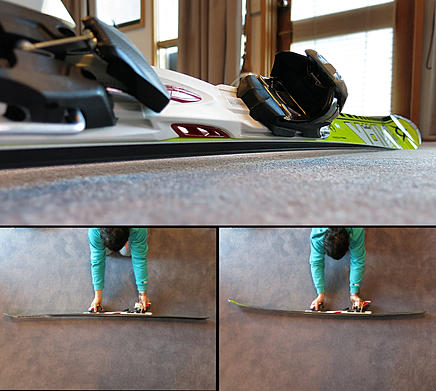
Camber is a "regular" ski design, where the ski is curved so that the tip and tail lay flat on the table while the middle would be 1/2 to 1 inch higher. The idea is that when you stand on the ski, this camber helps send more pressure/weight to the front and tail of the ski, so you can use effectively more of the edge and can carve better.
So, sidecut and camber together allow us to turn the ski just by putting them on edge: the ski will distribute the weight tip/tail and bend into an arc and basically turn by itself.
.todo pic with camber ski and weight distribution
Rocker is effectively the opposite of camber, where the tip and tail are actually rising when the middle of the ski is flat on a table. Skis with deep rocker look as if they are already pre-bent into a turn shape, but this also provides less weight distribution front and back and less effective edge when tipped on edge, so these skis also tend to be longer and fatter and are really designed for powder, as the rocker shape helps make it float on top of the powder, but not that useful on today's groomed piste.
However, marketing works wonders and most types of "on piste" skis today have some nominal amount of "rocker" at the tip and/or tail, to help with turn initiation or so they say. They will indeed help a bit when you have a bad snow day, as the rocker tip will tend to float on top of the chopped up snow.
There are also all sorts of hybrid skis, where all kinds of technologies are mixed, like dual radius skis, rocker tip only etc.
Not to say that these technologies don't work, but with good technique, all you really need is a shaped, cambered ski. In fact all these technologies make it easier for a lower skilled skier to venture on powder or chop and go faster than his or her current skill allows. Sure it can be fun, but wouldn't it be better if you first learned some technique and built up some skill?
If you absolutely must have the newest biggest thing, go for it, but do not exaggerate.
Manufacturing
The composition of the ski will tell us a lot about its behaviour and this is something you can read about, look out for in reviews etc:
- flexing (wood vs wood and metal or fibers)
- vibration (vibration damping technologies)
- lateral stiffness
- sandwich vs cap construction
- etc
Other
There are many other elements, that we'll explore in Ski behaviour and testing, such as:
- flex pattern
- tune
- position and type of bindings:
- fore/aft
- lifters and plates
- angles
Some basic criteria
If you're about to buy a pair of skis, here's some thoughts to help you choose.
The fatter the ski, the better it floats on powder and the worse it is on groomed. It takes more work to tip a fat ski on edge than a narrow ski. Also, grip on ice is greatly reduced. 70mm is a good waist for hard snow, don't go a lot above 80 and expect to learn to ski well.
The more "traditional" rocker you have, the less edge you have available on hard-pack and ice.