Some physics - how the skis work
On piste skis have a shape to them, an "hourglass" shape: wider tips and tails and narrower underfoot. The reason is so that when we put them on edge to make a turn, the ski will bend and turn by itself.
The reason so many websites and even books are stuck discussing the "new design" is because they have old content: in the older days, skis used to be much more straight and thus harder to turn. The average technique was to hop and twist the skis in the new direction, but those days are gone (we want quite the opposite).
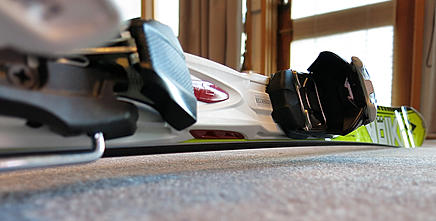
So, here is a ski on edge, with and without pressure on it:
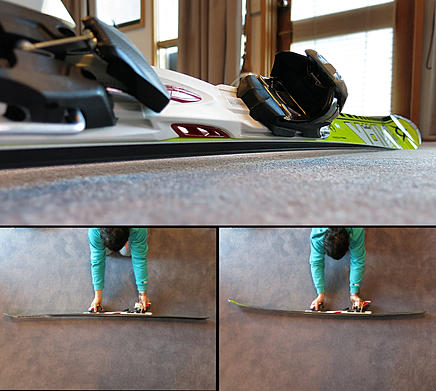
You can see the arc the ski bends itself into. They will not always make a turn with this same arc, that depends on many other things (like speed and snow conditions) but it will certainly turn.
That's all there is to it: to turn the skis, we have to put them on edge and apply weight (hint: stand on it). A turn will follow, with no other input!
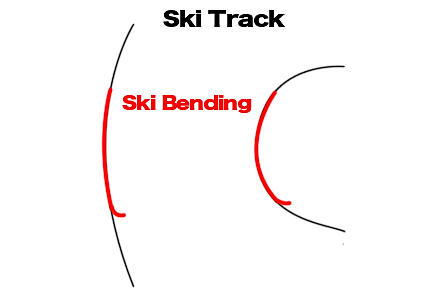
The more you put the ski on edge, the more it bends and the more it turns. Also, the more pressure/weight is on it, the more it bends and the more it turns, so we'll be talking a lot about weight transfer.
The ski does not have to be carving for the shape, the sidecut to create a turn. In reality, a shaped ski will start to bend and create a turn as soon as it is put on edge! There is a "critical" edge angle at which it will start to carve, but carving is not necessary for the ski to work.
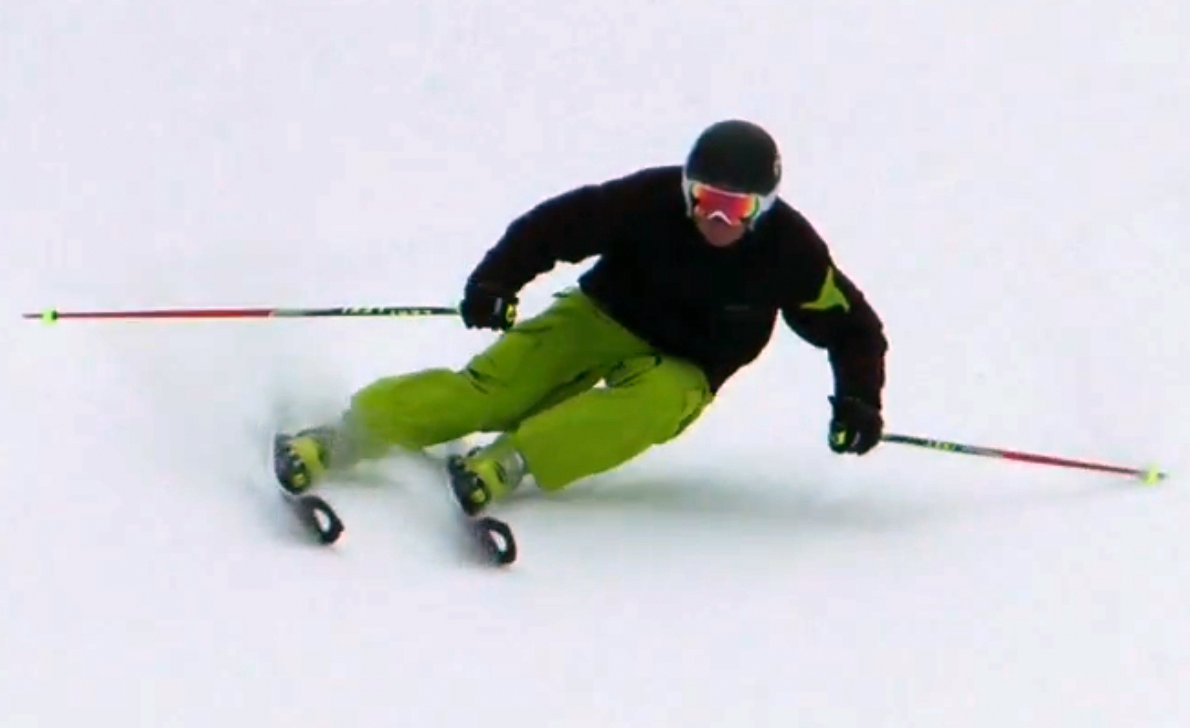
Here's how a very stiff race ski bends in a tight high-performance turn - looking at the outside ski tip bending below, imagine how tight the radius of the turn will be:
Take the skis on a carpet, as shown in the photos above and see for yourself. Bend it. Then bend it some more.
Then on snow - the same thing, see how it digs in:
Stand on skis, with the skis very close. Move the right ski two boot widths away from you and then transfer weight to it. See how it bends. Move it one foot away and transfer weight to it - that will put it on edge more. See how much more it bends.
Factors influencing the bending of the ski
Several factors are influencing the bending of the ski and the resulting turn on snow:
- snow condition - support: softer snow cannot support the ski enough to allow it to bend more
- pressure - angles: more pressure bends more, but the pressure is usually proportional to the angles at which the ski is tipped, see below
- tipping angles: more angles allow the ski to bend more
- snow condition - compressing: softer snow compresses more when more pressure is applied at an angle - so compacting snow underfoot also allows the ski to bend more, that's why "hero snow" is called, well, "hero" snow...
- fore/aft - the more weight is distributed forward of center, the more effective leverage ie exerted on the front half of the ski, leading to more bending of that part - this is minimal though. Likely
- timing - when is the ski engaged in the turn? Differences in timing and engaging the tips can reduce the resulting radius, even without more ski bend
- ski twisting: all skis twist under pressure, which reduces the effective edge angle and engagement at the tip and tail, somewhat, which also affects the resulting turn radius to some extent. The stiffer the ski (race skis are very stiff) the less they twist under pressure
So one of the things playing into the actual radius is the compacting of the snow underfoot. At 2-3g, the center of the ski will compact more snow underfoot than do the tips and tail (typical stiff race ski distributes something like 20%/20% of pressure to tip and tail - consumer skis keep even more underfoot) - another departure from idealized mathematical models, that I haven't calculated yet (and may never get to, heh). Combined with bigger edge angles, which require less snow to compact, this should influence the resulting ski bend and effective radius.
When looking at the sidecut printed on the ski, that's just a measure of the effective radius at a given nominal ski edge angles and you can easily bend the ski more - by tipping at a bigger angle than the nominal calculation. Here's a good calculation visualization http://diginfo.ru/en/alpine-ski/ski-sidecut-radius-and-radius-of-a-carved-turn/. I also have a hunch that by being more "forward" than aft, the effective radius on hard snow is smaller - but I haven't done any calculations on that either... it could be that the forward part bends more or that the tail slips... or that the ski engages earlier thus turns more time - that's the issue with idealized math ;)
.todo add diagram with force distribution along the ski and difference between beginner soft ski and race ski in tip/tail force distribution
Here is a very good demonstration and discussion of ski bending at different angles:
See Bending the skis if you want more details.
Skidding and steering
So far we've considered the case of a carved turn, due to sidecut and ski bend only. However, most skiers don't do carved turns most of the time, they do what is called a skidded turn.
The position of the binding along the ski causes a "self-steering" effect to appear. Normally, most bindings are mounted behind the center of the ski, so the pressure applied by the skier is biased to the rear. This introduces a self-steering effect when the ski edge is not locked in a carved turn.
This is the basic foundation for skiing non-carved turns: merely by putting the ski on edge less than it would take for the edge to lock into a carved turn, the ski will self-steer into a skidded turn, based on:
- sidecut, which describes an arc when on edge, which, even when not engaged fully (locked carve) will still guide the ski around a turn to some extent
- rear-biased pressure from the skier's weight, which will cause the rear of the ski to skid more than the front of it, creating a torque that steers the ski around the turn.
.todo draw some diagrams for this effect as well