Receiving pressure
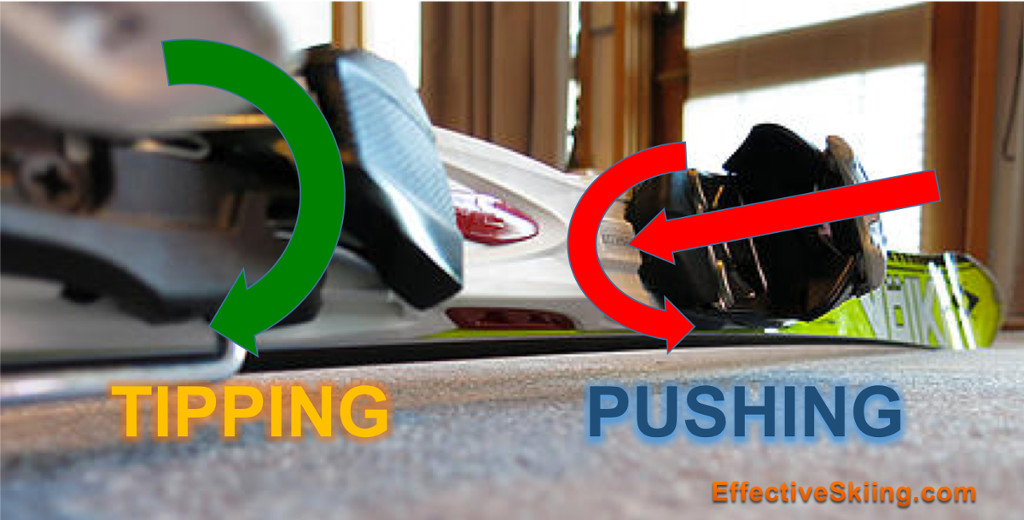
It is important to distinguish between artificially creating pressure and allowing the pressure to build as the skis turn across the direction of travel. This is one of the recurring themes among skiers at the highest levels of expert skiing.
The original title of this topic was going to be passive pressure or passive extension, but I liked the term receiving pressure, from JF Beaulieu, contrasted with giving pressure i.e. pushing into the ski.
Also, a recurring theme on our website, avoiding pressure at the top of the turn is critical, to allow building big angles:
So how does pressure appear?
Well, glad you asked... the obvious question :). Instead of creating pressure by pushing against the skis (or moving away from the ski - another common coaching meme), we simply allow pressure to appear or build up under the outside ski, as the ski turns across the direction of travel.
This would be similar to you feeling pushed into the side of the chair when the car turns quickly, or into the seat of a leaning bicycle during a tight turn at speed, etc.
Why exactly does pressure appear?
Well, it basically appears from the interaction of the ski's edge/sidecut and the snow, but in terms of physics, it appears because of the principle of Action and reaction:
For every action, there is an equal and opposite reaction.
The passive part or the receiving part comes in as we look at the ski turning across the direction of travel: as the ski comes around the turn, tipped and engaged, the body's inertia will cause the ski to push back, basically causes the pressure to appear, without the skier doing much.
This explains why for instance expert skiers can ski at a high level of performance for a long time: because they learned to receive pressure with minimum effort, as opposed to working hard at creating it.
How much?
Well, it is a matter of how much our body pushes into the ski, so how fast we're skiing and how quickly the ski comes across the direction of travel.
Why?
Why do we need the pressure? It is one of the ingredients that bend the ski and create deflection, i.e. give us a lateral impulse, from turn to turn.
Where?
Right - of course, you keep probably thinking that your body meets the pressure "down the hill" or "forward", i.e. when the skis have completed turning... prepare to be surprised.
Get expert to see this · $60/yr
So... what do I do?
Good question.
Get expert to see this · $60/yr
Advanced biomechanics
Get fast-track to see this · $80/yr
Read more: